Showing posts with label quotation. Show all posts

Oct 25, 2015

European Commission Workshop - Contracts for translation services


What the Linguistic Sausage Producers don't want you to know:
Did you know that tenders for work with the European Commission are not just for the big Wortwurstläden but can be submitted by individual translators who are EU citizens - and that these individuals have equal standing before the Directorate General for Translation? The DGT does not differentiate and many of its best external contractors are individuals, either self-employed persons or dynamic teams of two or three professionals.

The DGT uses taxpayers’ money and must be transparent, with fair and equal treatment for each candidate. Reading their specifications may appear daunting at first, but taking a closer look is worthwhile! Questions may be submitted and are answered during the weeks when the call for tender is open; this can be done in three languages, almost in real time, with all questions and replies made public on the DGT web site.

Quality pays and they will pay for quality: decisions are based on a quality/price ratio of 70/30, in favor of quality. For each job done, a quality note with feedback is sent to facilitate ongoing improvement.

But to get this far, you must first submit a persuasive offer to the selection board.

On November 28, 2015 from noon to 4 pm, IAPTI's UK chapter is hosting a workshop in Manchester (UK) to inform you of what it takes to tender and win at Europe's highest public level for translation. Profit from this important business event at yet another iconic venue! Registration information is available here.

The beautiful Manchester Central Library, venue for the EC tender workshop!

*******

The speaker: Monica Garcia-Soriano started her EU career as a lawyer linguist 24 years ago at the Court of Justice in Luxembourg. She later joined the Spanish Translation Unit at the European Commission in Brussels and for the last 8 years she has been in charge of procurement at the Commission's External Translation Unit.

Oct 21, 2012

Put OCR in Your Business Model

This article originally appeared on an online translators portal four years ago and was long overdue for removal there. Here is an update.

*****
Optical character recognition (OCR) software is discussed often online and at translators' events, usually in the context of how to deal with PDF files. Hector Calabia, Peter Linton and others have made a useful technical contributions on this subject in articles and forums and at various conferences. However, it is useful to consider OCR software in a broader translation business context. Document conversion is often very useful for translation purposes and greatly facilitates automated quality checks of the draft, for example, but OCR can also generate additional income for your business and reduce quotation risk.
OCR for translation
There are a number of programs available for this purpose, and which one is best for your purposes may depend on the language combinations you deal with and other factors. For years now I have used Abbyy FineReader, because years ago it gave the best test results for the particular set of European languages one of our clients offered. It is also relatively inexpensive (I paid about 100 euros for FineReader 11) and easy to use.

Many OCR conversions of TIFF, JPEG and PDF documents which I receive from agencies are difficult to use for translation purposes and require significant modification - if they can be used at all. Particularly in cases where TM tools are to be used or target texts differ significantly in length (especially when they are longer) there may be problems. The best ways to avoid these problems are
  • avoid automatic settings for OCR conversions; use zone definitions instead
  • avoid saving the converted texts with full formatting in most cases
  • use a suitable post-OCR workflow to clean up the converted document by joining broken sentences, removing superfluous characters, fixing conversion errors, etc.
If the idea of doing individual zone definitions on each page of a 100 page document is intimidating, take heart. Programs such as Abbyy FineReader often allow you to define layout templates, speeding up the work considerably. One translator I know became so skilled at the use of these OCR templates and was so good with his conversions that agencies hire him just to do high-quality OCR work for them. Which brings me to….

OCR as an income-generating activity for the translator or agency
Hardcopy, scanned documents, faxes and PDF documents generally require more work for translators than electronically editable documents and require different, sometimes more fallible quality control measures than a typical workflow for a translator using original electronic documents in a translation memory system. If no conversion is performed, it is more time-consuming to check terminology or use concordances during the translation, and it is also unfortunately too easy for eyes to skip over bits of text. Under time pressure this can lead to very serious problems. Even with conversion, the OCR text requires careful checking against the original document to identify and correct any errors introduced (and there will be some at times with even the best OCR software). So it is not at all unreasonable for a translator to charge a higher rate for dealing with hardcopy, scanned documents, faxes and PDF documents.

There are a number of ways to incorporate these higher charges into your business model. The two obvious ways are a premium (surcharged) word/line/page rate and hourly service charges. I usually offer both options to my clients, with the word/line rate surcharge representing the “fixed” rate and the hourly rate the “flexible” rate where I make an non-binding estimate and they may end up paying more or less according to the actual effort. For pure OCR conversion jobs where I am not doing the translating, I charge a typical proofreading rate or a bit more, because I go through the entire document and see that it is correctly formatted for translation work and that obvious errors are fixed (i.e. basic spellcheck, etc.).

Sometimes I hear that “the client doesn’t want to pay for that”. Well, that’s OK, too. The client has the option of doing the work and doing it right and saving me the effort. The recognition that there is additional effort involved and that this effort should be compensated is important. But usually there is a way to sugar-coat the "bitter" cost pill, and this is where your marketing savvy comes into play. Some win-win arguments you might present include:
  • the availability of an editable source text the client can use for future versions;
  • the ability to create TM resources using the OCR text (which can save time/money later);
  • potentially better quality assurance, especially with tight deadlines. 
Returning a clean, nicely formatted OCR of the source document is often good "advertising". End clients may appreciate how this saves time and allows them to use the original text in a variety of ways (attorneys may like to quote arguments from the opposing side, and copy/paste beats retyping). Discriminating agencies may recognize your skill at creating documents that don’t go crazy when edited (because of screwy text boxes, bad font definitions and other format errors) and offer you more work. If your language pair is in low demand or is very competitive, this may be one more way of distinguishing yourself from the pack.
I got started doing OCR work and charging for it after suffering through the conversion of several long PDF documents by more manual methods. I finally wised up, bought FineReader and started to use it with most of the hardcopy, scanned documents, faxes and PDF documents I received simply because it enabled me to use my TM tools and do better quality checks. I started sending the cleaner-looking source texts converted with OCR along with the target text translations, and soon I started getting requests for paid OCR work. A number of my agency clients then began to buy OCR tols and use them with varying degrees of success. Even if they do all the conversion work, I still win if they do it right, because I save time for what I enjoy more – the translation.

OCR as tool for quotation
Some people I know still haven’t learned to do a high-quality OCR (or they don’t care to), but they still use the software effectively in a very important area of their business: quotation and risk limitation.

There are lots of good tools out there for text counting, which is important to many methods of costing and time planning in the translation business. Some people even still do it manually, which, though time consuming, is not a bad way of checking the numbers from an electronic estimate. A number of factors can result in text counts being too low – embedded objects, such Excel tables or PowerPoint slides in a Microsoft Word documents, or graphics with text - or even too high (as is the case with at least one CAT tool counting RTF and MS Word files). Keep using whichever method you prefer - I won't try to persuade you that any one approach is best. I use a number of methods myself.

When translating larger documents, however, or documents with a complex structure, it is often useful to have a “sanity check” for your text counts. On a number of occasions I have received translation jobs from agency clients where the text count was given a X words, where in fact there were quite a few more words embedded in Excel objects, bitmap graphics, Visio charts, etc. which had not been measured by the method used. In a few cases these clients had to take a loss on the job after giving a fixed price bid to the end client. Using OCR to check your estimates can prevent such an unfortunate scenario.

To do this, print the document (whatever it is) to a PDF file. Then run the PDF file through an OCR program with automatic settings (to save time – you don’t need to translate this OCR). Save the text and count it. There will probably be a bit more text due to headers or footers or perhaps garbage from graphics, but the results should be close to your other estimate. (You can always subtract an appropriate factor for the text count in headers and footers to improve your OCR estimate.) If there is a major deviation, this is a clear sign that you should take a much closer look at the document(s) before quoting the job.

Searchable scanned documents
Another use I have found for OCR in recent years is creating searchable "text-on-image" documents from scanned PDFs, TIFF files and other bitmap formats. Although I have used these searchable PDFs mostly for reference while I work (searching for bits of text while viewing the original, unadulterated context) and supplied them to clients on only a few occasions, the potential for an additional value-added service is fairly obvious in this case.

Conclusion
OCR software is an essential tool for the work of many translators today, even more so than CAT software in many cases. Not just a tool for recovering “lost” electronic documents or making legacy typed material more accessible for translation work, it also offers possibilities for generating additional projects and income, differentiating one’s services and reducing risks when quoting large jobs. Key features of whatever OCR you choose should include the ability to select text areas for conversion and to determine their sequence in the converted text (using user-defined zones). Various options for saving the converted text (full page format, limited text formatting and no formatting) are also very helpful. Most important of all, though, is a good quality-checking workflow for your OCR documents (possibly including formatting) to avoid difficulties in the translation process and ensure that your work has a polished, professional appearance.

OCR software is another good tool for improving your visibility with clients and making your work processes easier in an age when many archiving and ERP systems are focused on the retention of PDF documents or TIFFs and even actively discourage saving original formats. The major providers of this software often have free, functional demonstration versions to use before making a purchase decision. Try several options and choose the best one for you. You won’t be sorry.

Sep 16, 2012

Equivalent Rates in Translation Billing

This article appeared in its original form in September 2008 on an online translation portal. It has been moved here for better maintenance of the content and links. The original text has been modified  slightly and the link to the quotation tool updated. The rate equivalence calculator is part of the Sodrat Suite for Translation Productivity. An older post on this topic includes links to other tools for calculating rate equivalency.


*****

Billing questions are seen very frequently in the forums of popular translator portals or professional association sites. Often these concern whether translations should be billed by the word or agglomerated words (thousands or hundreds), lines, pages or other units in the source or target text. The answers to these questions reveal a wide range of approaches, which are often dictated by local convention, habit or simple fear. Often it is claimed that a particular method "does not make sense" because of compound word structures or other issues (which is frequently claimed for my language pair, German to English, for example). These claims are interesting, because other successful translators with the same language combinations often view things very differently. Who is right?

Before answering that question, let’s ask what sort of an answer can be trusted most. Would you stake your business on a “gut feeling” recommendation of another translator or translators when many others argue just as vehemently without evidence? Or would you feel more secure using a mysterious online calculator on an agency web site which purports to be based on a large body of text in the respective languages? Or would you prefer to see hard numbers based on your own translations that you have carried out in a number of different fields for various customers? Which approach do you think would give you the best basis for making your business decisions and protecting yourself against getting shortchanged in pricing?

I prefer to deal with real data from my own work. It not only reflects what I have been translating but also what I am likely to be translating in the next year or two. If I make a radical change I can quickly check and make sure that my pricing model is still “safe”.

To answer my own pricing questions, I created a spreadsheet in Microsoft Excel, which allows me to enter the actual data from individual projects and see what the relationship between target and source text pricing would be for words, lines and pages. You can have a copy of this spreadsheet to use yourself by downloading it here.

Because the true measure of price appropriateness is reflected in what one actually earns for the time spent working, a tracking calculator for the hourly earnings on each job was included in that spreadsheet to serve as a "control", but here I would like to focus on the relationship between different unit costing approaches and how to “adjust” prices to the units your prospect or customer is most comfortable with.

When I entered actual data from two types of translation work that I do (one specialized, the other a general category), I discovered some interesting things. I set up my spreadsheet to calculate the relative standard deviations (RSD) of the data, and what I found was that these were generally under 5%. What does this really mean? It means that if the data for your translation jobs is normally distributed, about 60% of the time the “actual” price relationship between two methods will fall in a “band” of plus or minus one RSD around the average, 95% of the time the actual relationship will be plus or minus two RSDs and 99% of the time it will be plus or minus 2.5 RSDs.

Still confused? Here’s a specific example from the downloadable spreadsheet:

If I want to earn € 0.15 per target word for a chemistry translation but the customer I am dealing with wants me to bill in source lines (allowing a “fixed price” to be calculated in advance – line rates are also common in Germany), I enter my desired rate in the little calculator table in cell B20. In cell E20 I see that I need to charge about € 1.27 per source line of 55 characters. How reliable is that figure? The relative standard deviation of the source line to target word ratio is just under 5% (some versions of the calculating spreadsheet in circulation do not include this figure, but it is accurate). This means that 99% of the time if you use this pricing, the “worst “real target word rate you achieve will be about 13.1 euro cents and the “best” you’ll do will be about 16.9 euro cents. If you work consistently with this pricing strategy your average earnings will be 15 euro cents per word. In many cases the bandwidth of variation will be much narrower than the example I have presented here. Compile your own data and see.

But what about the “exception” the fearful translator might say? One indicator of trouble for my language pair if I am using a source word pricing strategy might be an unusually low source word to source line ratio, which would indicate the likely presence of very long compound words in German. What do you do in a case like this? Raise your price if you feel like it. Use real data to show that this text really is different and must be priced differently from other work. Not everyone will agree with this idea, but you may have more success with it than you would expect. The important point here is that, by tracking actual data from your own work, you have a much clearer understanding of when rates may need adjusting. 

When you examine your own data you will find that the actual variation in earnings between the calculation methods presented is small in most cases, at least for European languages. If this is not the case for your language, then you will have hard numbers to use in your quotation. Negotiations based on fact often work better, though all this can be greatly outweighed or offset by psychological factors.

By using the rate equivalence spreadsheet or creating your own similar tool, you can navigate the hazards of various quotation methods with greater confidence, quickly determining equivalent rates in the units expected by prospects and customers. This will ensure that you reach your average earning targets and achieve the same average hourly earnings as with your familiar unit pricing. You’ll know how much you have to raise your word price or how much margin you have to reduce it if you are asked to quote by source word instead of target word or vice versa. Now get down to business.

May 29, 2012

memoQfest 2012: another great year and great things ahead


Some say translation technology has gone to the dogs, and
this was certainly the case in Budapest this year as Ajax
and Benny noted to their satisfaction.
Although I was first asked to consider memoQ by a client of mine in 2007 and actually began to look it a year later, I was very skeptical about the software when István Lengyel convinced me to take a break for the first memoQfest at the Benzcur Hotel in Budapest in 2009. I had seen interesting progress in the year I had tested the software, but it was simply too immature for my needs and lacked nearly all the features which were most important to me. About a week before the conference, Kilgray released a version that barely met my minimum requirements for a small portion of my clients. I was impressed and actually did my first bit of commercial work with memoQ - a press release - the night before the conference began. The event itself was a blast, and I was convinced that this team had the right stuff or at least the potential to make it.

The next two years confirmed the wisdom of this leap of faith as the company raced from strength to strength despite a few stubbed toes; the advance of memoQ clearly played a role in improving other leading tools like DVX and SDL Trados, the latter borrowing generously from Hungarian innovation or using it and the unmatched service ethos on the Danube as an inspiration to overhaul the catastrophic mess of legacy Trados and enter the modern age of CAT tools, even surpassing memoQ in a few points, though with the current Renaissance of creative development in what appeared just a few years ago to be a dead-end IT ghetto, it's not an easy guess as to who will stay ahead anywhere for long. These are indeed good times for users despite the renewed threats of lock-in posed by the current misguided server politics of most providers.

Nonetheless, Kilgray's rapid growth has not been without difficulties, and despite anticipating most of the challenges long before they arose, the team doesn't always put in the performance its demanding fans expect. This is often to be expected when a company experiences the exponental growth which can obscure long-turm interests in the confusing melee of daily business. And the product which seemed so fresh and clean just a few years ago is beginning to look like a car that has been taken on too many roatrips without a good cleaning, has hauled too many dogs and needs new tires. But last week I saw clear signs that there may be a new Maserati getting a tune-up in the development garage. The hints regarding memoQ 6 and the company's further roadmap led me to scratch of most of the items on my technical gripe list. The organizational wishlist has gotten longer, but it's clear that the "refactoring" process at Kilgray is not limited to the software, so I think I can trust them as I did four years ago when few could have anticipated the company's impressive track record.

I almost did not go to Budapest this year. When I read the published schedule, it sounded far too skewed toward corporate interests, a bit like a sell-out now that server sales revenue has far surpassed that from Translator Pro licenses. And bad calls like the confused differences in implementation of versioning features in memoQ 5, weariness from providing support for issues arising from a lack of professional service consulting in the sales process with some of my agency clients and my own stupidity of forgetting to vaccinate my puppy against rabies before the trip (which required me to leave him with someone else for the first time) had me considering a week of vacation at home.

That would have been a mistake. I only expected to draw value from one presentation - regular expressions by Polish guru Marek Pawelec - and even there I didn't expect to understand very much. Instead, every one of the rather random sessions I attended had a lot to offer, even for a freelancer. The agency presenters who talked about their approaches to challenges in complex translation projects shared a great deal of information that is directly relevant to my agency and direct client business and can help make it better. And the general talk on refactoring your business through innovation by Richard Brooks, which I expected to be the biggest hot air balloon of the week, was the absolute highlight for me. I might even have gotten something out of the Asia Online keynote on machine translation, though an idiotic quote I read from the speaker about how we need to get on the MT boat or drown suggests perhaps not. I do hold out some hope he might have been misquoted or taken out of context, however. It's the least I can do in a world where people still believe in the Tooth Fairy and US Republican politics.

When Kilgray releases the videos of the talks, do watch them. I do hope the sound and picture quality will be good, because too often I really did wish I could have been in two rooms at once.

The Twitstream shared a lot of the gritty details of the presentations; the hashtag #memoQfest or an archive established by a Ukrainian user will show these for a while at least. And I'll be drawing on the tweets, my other notes and the memories of conversations in the breaks to share insights, many quite trivial, all of which confirm that memoQ is the right choice for most of my translation IT needs. The only thing I'll say now is that in memoQ 6 the versioning features will be the same in all editions of memoQ. Big deal. For some of us.

Oh yes, and next year's memoQ fest might not be in Budapest. If I weren't visiting that city with some frequency now for dogs, I might be disappointed, because I love it and the rest of the country I have seen, but the change is unlikely to be a problem, because what makes Kilgray's memoQ truly great is not the venue and not the rather good technology, but the people: the ones who make it and the ones who use it.


May 29, 2011

Pricing right

Some topics are more persistent than a swarm of mosquitos at swampside; translation rates is one of these. Many of these discussions become quite lively, and often points are made which are fully opposite to one another yet quite right in their respective contexts. The contexts to consider include, of course, the translation submarket served, the level of service offered and, inevitably, the chutzpah factor. Some of my best rates for translation derive from that last alone: call me at 5:30 pm on a Friday afternoon after a long, hard week with a 10,000 word rush job for Monday morning and ask for my 'best rate' and I'll promise you my very best :-)

Not long ago there were a few thoughtful and thought-provoking threads on Corinne McKay's Thoughts on Translation blog that explored the issues of earnings and setting rates for language services. It started off with a thread on how much freelancers earn (with more than 80 comments to date!), then after shots were traded between Chris Durban and others over the magic 40-cent-per-word milestone, a follow-up post carried the discussion further. Both of those and the discussion of volume discounts on the same blog are worth reading and considering for your situation.

Except for the laziness of most wannabe translators in matters of research, one might think that this discussion would have died out ages ago except perhaps for strategic exchanges of information on how one might quote more appropriately in a particular market segment or for discussions of new developments like a real or imagined economic crisis and the opportunities it provides. The routine answers are, after all, available for anyone wiling to wade through a swamp of dis- and misinformation.

There are basically three approaches to pricing levels: (1) determining sustenance levels by calculating expenses, available time and approximate productivity and hopefully not forgetting long-term needs like retirement savings and medical insurance where relevant, then setting rates accordingly; (2) herd pricing (charging what others charge more or less, or what you think they do); and (3) value pricing (what the market will bear).

The first approach is one often recommended to beginners or those who are struggling to pay bills, perhaps despite a heavy workload. It is indeed a useful exercise to do the math: add up all your expenses, your anticipated need to save for the (un)certain future, and divide it all up by how many hours you expect to work to get an hourly rate. Divide that by your output, and you'll have a target piece rate for your slave labor below which you should not go lest hunger take you in its greedy jaws. For those lacking an overview of such matters, there are any number of useful guidelines for this available on the Internet; even ProZ offers a somewhat reasonable "rate calculator" for determining this baseline. It's useful to do these calculations from time to time as one's life circumstances change to ensure that the rates charged are at least sustainable; in highly competitive situations with price pressure, this may be essential. But ultimately I consider this a foolish, limiting approach that may either ignore opportunity or be totally irrelevant given the realities of a particular market. If you calculate a required target rate of ten cents per source word with your output and your 'niche' will expect you to charge three cents, it's time to change your game.

Herd pricing seems to be the path most taken, possibly because it requires no math and often less thinking. "What do you charge?" is a frequent question among translation colleagues, and to the extent that it is honestly answered, it may provide some useful information. I prefer my answers of this sort pooled in some way, such as the BDÜ rate surveys, though with these I sorely miss information on standard deviations. How can I aspire to being a six-sigma translator when it comes to rates if I don't know what the standard deviation is? I like to know what my 'competitors' charge as much as the next guy or gal, but ultimately, this is really not what my pricing should be based on.

From a proper running dog capitalist perspective, a 'fair rate' is what the market will bear. If, for the instructions shipped with an electric toaster, the market will bear a piece rate that translates to three euros per hour net earnings for me, then dems da breakz, I accept it, let that work go to Calcutta with a smile and move on. Given a recent chat I had with an agency owner and friend, there seems to be more of this, so much so that he described anyone willing to pay my rates for ordinary technical translation as simply 'clueless'. Maybe. I like to think of my customers as 'lawsuit averse' or 'marketing savvy' rather than clueless, but then the national motto where I come from isn't Geiz ist geil.

'What the market will bear' is in reality quite variable, and fair is a subjective thing however objectively some attempt to define it, but I rather like the fact that this requires us as business people to stay awake and be sensitive to our needs and those of our customers as well as their perceptions. I live in Germany, the land of 'thought experiments', so I'll propose one to the cut-rate colleagues in various developing corners of the world:
Imagine that your client requires the translation of a project proposal overnight. The amount of work to be done is horrendous and requires a carefully coordinated, all-out, all-night effort by skilled specialists. Competitors in this RFP will most likely not be greatly differentiated in price or delivery times; in the end, if the decision doesn't rest on a bribe it may come down to naked persuasion, the psychology and semantics of the proposal itself. If successful, this bid will result in millions of euros in new business and strong, guaranteed growth for the next few years.
What is the fair price for that work? Or to consider a simpler example, one frequently encountered by translators, what is the fair price of 'translating' a culturally sensitive marketing slogan? Would you price it by the word? By the line? By the hour? Any of these would be wrong I think. And if the value to the customer is low, the price should be low. If the stakes are higher....

Jun 15, 2010

Receiving an e-mail inquiry from an existing client and quotation in OTM

There are a number of ways to create new projects in OTM from lsp.net. The workflow described here shows how to use an e-mail request from an existing client as the basis for a new project quotation.

The OTM Task Board shows an "orphaned e-mail"

media_1276299350469.jpg
When an e-mail is sent to the project management address in the Online Translation Manager from lsp.net, if it cannot be clearly associated with an existing project (via the project reference number) it is classified as an "orphaned e-mail" until it has been read and processed. Here a quotation request has been received from an existing customer; there is not yet a project associated with this request. Clicking the blue subject title or the Select button opens the mail to read it.

Read the e-mail

media_1276299475750.jpg
The e-mail contains an attached file and a request for a quotation. Clicking the button marked at the bottom of the e-mail will begin the quotation process. In an agency with multiple project managers, the drop-down field and button above the message could be used to assign the mail to an individual for processing.

Fill in the details on the project form

media_1276299753151.jpg
The quotation request form automatically copies certain details from the customer's master record. Here you add general informatio and notes relevant to the quotation. The volume and requested deadline fields are free text fields here, which are used for display in correspondence but not in calculation at this point. The lower part of the form (shown in the next step) contains a copy of the original e-mail message to be used as a reference while you fill in the quotation details. It is important to fill in the project name here, as it is used in the quotation and invoice documents. This is an appropriate place to write purchase order numbers or other data required by the client.

Add project notes and submit the request

Add_project_notes_and_submit_the_request.jpg
Here is the lower part of the project request form. A copy of the original message text is included here and can be overwritten, or notes regarding special considerations for the project can be added. Clicking the marked button and the bottom of the form will submit the quotation request and continue the process.

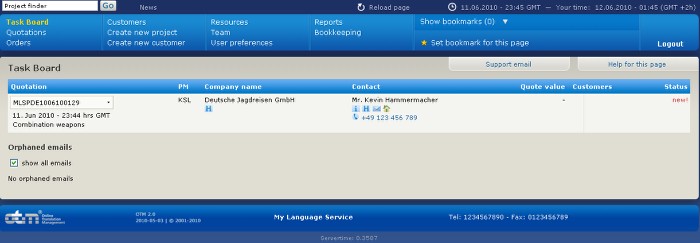
The task board shows the new quotation request

media_1276299935403.jpg
The task board now shows the new quotation request. The request will remain there on the "to-do" list until the request has been read and handled. The drop-down field in the quotation column enables access to all displays for the quotation. Use this to navigate to the "project switchboard".

Project switchboard view

Project_switchboard_view.jpg
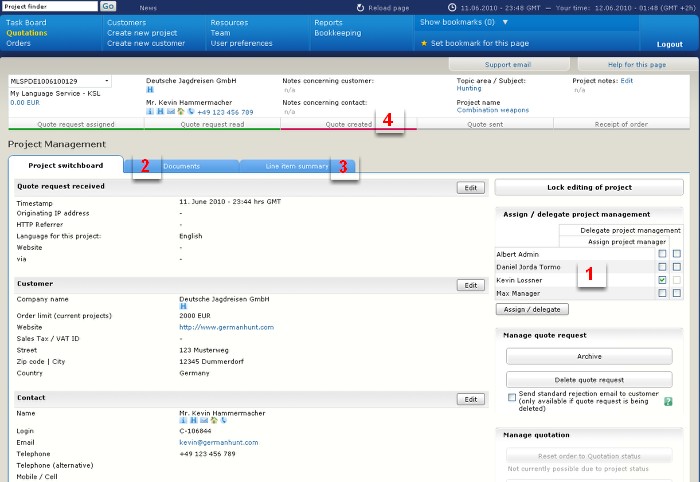
The project switchboard view enables customer and project data to be edited, a project manager to be assigned (see the area marked "1"), relevant documents (["2"]such as stored NDAs and contracts, price lists, terms and conditions from the customer, etc.) to be viewed, line items ["3"] in the quotation to be checked (none of those yet) as well as navigation through the quotation process via the step bar ["4"] below the summary at the top. Click "Quote created" in the step bar to continue. Because this step has not been completed, it is underlined in red. Status signals in the step bar follow the traffic light principle.

Composing the quotation

Composing_the_quotation.jpg
The "Address and settings" tab of the quote display enable you to customize the letter to be sent with the PSDF quotatio document. Make whatever changes are required here, then select the line items tab to continue to the actual quotation. The currency for the quotation can be set here, and the lower part of the form (not shown) allows specialty areas to be specified, which may be of use in identifying translators to handle the translation.

Line items tab

Line_items_tab.jpg
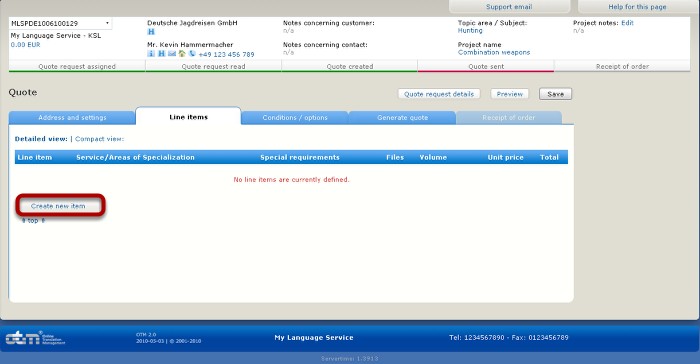
Click the "Create new item" button to create a line item for the quotation. If you create running invoices for monthly billing or similar, each line item on the invoice will be entered separately this way.

Line item entry

Line_item_entry.jpg
Select the languages for the line item on this tab (Service / Special Requirements) and enter notes to be included on the quotation regarding special requirements. The notes are free text, and a number of pre-configured suggestions are provided. Note the selection shortcuts under the drop-down fields for language selection. When you are finished on this tab, click the Quantification / Price tab to continue.

Specify quantity, price, etc.

Specify_quantity__price__etc..jpg
Select the files for the line item here (only one in this case, but if there were more in the project, all would be available here for selection). Enter the appropriate costing information, then click the Save item button.

Completed line item and quotation cost summary

Completed_line_item_and_quotation_cost_summary.jpg
After saving the item, the cost summary is shown. Clicking the line item enables it to be edited. Additional line items can also be added here. Continue now by clicking the "Generate quote" tab to create a quotation document to send to the customer (or just to file for your reference).

Cover letter for the quotation

Cover_letter_for_the_quotation.jpg
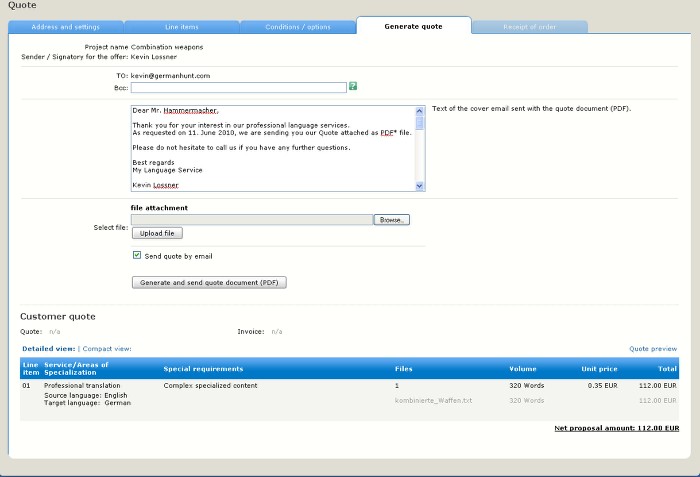
The quotation cover letter can be customized here. If you do not wish the quote to be sent to the client, unmark the corresponding checkbox. (You can, of course, skip the quotation entirely and go straight to the receipt of the order after the line items are entered.) After the quote is generated, the view returns to the Project Switchboard.

PDF quotation document

PDF_quotation_document.jpg
This is the first page of the quote. Typically, the PDF file generated includes a company profile, references and terms and conditions of business.


Related posts:


May 24, 2009

Charging for formatting with CAT tool work

Last year I had the displeasure of translating a file with particularly heavy formatting. Not only was it loaded with colored text, bold and italic type, it also had a lot of hidden text notes that were not to be translated. It was so bad that it inspired me to write a short guide on how to prepare MS Word and RTF files with content to exclude for translation in Trados or DVX. However, it also got me thinking that I really ought to find a reasonable way to start charging for the extra trouble of all these formatting tags. Clients have advantages from their inclusion in a job, but translators have extra work because of them, and this extra work should be compensated.

One possibility might be to take the count of inline tags (or codes as DVX calls them) and count each as the equivalent of half a word in addition to the usual measured word count. This would represent a fair level of compensation for correctly placing tags for cross-references, character formatting, etc. in a target sentence. It is also simpler and makes more sense than other ideas I was considering which involved statistical measurements of translation time differences as correlated to tag density in a text. Any other ideas? Objections to charging for real effort?

Dec 17, 2008

No mercy for PDF jobs!

I'm always amazed at the BOHICA attitude of many translators and agencies when it comes to PDF documents submitted for translation. As we all know, these usually involve considerably more effort to produce a document which often falls short of the original in terms of the quality of its layout or other factors. I've addressed this issue in the past by lecturing on handling PDF documents at conference in Berlin together with an expert on the subject, the German/Swedish/English translator Peter Linton, as well as publishing a short article on including OCR in one's business model and providing some guidelines for post-OCR workflow and QA that cover PDF and other formats.

To many people in our industry are hesitant to charge for the real nuisance involved in working with PDF documents of all kind, and they do end customers a great disservice by not educating them in the fact that PDF is not a valid format for translation. The number of ignorant queries from translators in online forums asking how to use Trados on PDF files indicates that this lack of knowledge is probably pandemic in some parts of our industry as well.

Aside from the fact that I have added many additional thousands of euros to our revenues for conversion work I had to do anyway simply by charging normal hourly rates for the effort, there is another big advantage to insisting on significant PDF surcharges (10 to 25% in my case). When the client knows exactly how much more a PDF job will cost, the "missing" original document in MS Word or other usable formats is often miraculously found. This happened to me again this morning. Last night I informed an outsourcer than an OCR conversion would take several days and cost at least an extra 400 euros, and this morning - wonder of wonders! - her client managed to find the original file, saving everyone much hassle and allowing those involved in the project to get started right away. A meek acceptance of the format without insisting on an extra charge would not have led to the result, and in a document with very complex tables, the end result for a team project with a tight deadline would have been a real disaster.

Nov 20, 2008

eBook: The Translator's Toolbox by Jost Zetzsche

Reviewed: Version 7.0 (November 2008)
Price USD 50
Format: PDF, CHM
Info link: http://www.internationalwriters.com/toolbox/

The 361 pages of this eBook are offer a wide-ranging overview of computer technology relevant to translators and its possibilities. It is delivered in two formats: PDF for better reading and Windows Help (CHM) for more efficient searching of topics. As the author describes it, "This book is not a tutorial on what to do or not to do with your computer. Instead, it is a list of suggestions based on what has worked well (or not so well) for me." As such, it is an excellent overview of value to translators at all levels of experience and technosavvy. The book focuses on tools and techniques for Windows users, so Mac and Linux fans will find a lot, but not all, of the material irrelevant.

Some of the sections I found interesting and useful covered:
  • Windows OS & techniques for optimizing it
  • Advanced browsing tips for Google (searching in page titles, excluding file types, text embedded in URLs, etc.)
  • Reducing risk from phishing, viruses, trojans and various other modes of attack
  • All sorts of utilities including collaboration tools, OCR, etc.
  • Office suites, DTP programs and graphics applications
  • CAT review / overview, including QA tools and TM quality maintenance
  • Terminology extraction and management tools
  • Localization tools
  • Management tools for your business
  • A quick reference for handling complex file formats
  • Voice recognition apps
The book was updated in November 2008, so the information is absolutely up to date as I write this. That's important in a field where the technology changes so rapidly and companies are busy swallowing each other and changing formerly independent tools into vassals of the Evil Empire and others.

The author, Mr. Zetzsche, has a great perspective and understanding of the technology scene. His discussion of CAT tools, for example, puts them in exactly the right perspective. As he noted, "We’re at a point in the development of translation environment tools when it’s generally understood that translation memory tools are not primarily time-saving applications; first and foremost they are programs that allow translators to increase the quality and consistency of their work." That is a very important point to remember when many translators, agencies and end clients think of them primarily as ways to speed up jobs and cut costs. My own experience, particularly when dealing with complex, heavily tagged formats, is that working with CAT tools can occasionally require much more effort (and should be charged accordingly), but that it is still worthwhile to do so because of the access to reference material in the environments. The higher quality that results produces downstream savings for customers, but there is no justification for applying discount scales to such projects.

The book is written in clear, competent English that is accessible to anyone who uses English as a working language. The range of topics is broad enough that almost anyone - from beginning translators and those without a clue regarding technology to those with a good understanding of the craft and its tools - will find something of value. The book is well worth the price.

Calculating equivalent rates for translation billing

Many of us who have dealt with an international clientele have encountered different approaches to counting text for charging translations. Charging by the word is probably the most common practice, but in various places one might encounter calculations per hundred words (Australia), thousand words (UK), "lines" (common in the German-speaking countries), "standard" pages or other units. Then, of course, there is the matter of charging by the source text count or by the target text count.

These issues are discussed at great length and with great passion by many translators, some of whom are convinced that only certain methods protect one against being "cheated" with particular language combinations. I can't judge the validity of this belief for every language, but when I hear that opinion expressed for the language pair I work in, I know it is nonsense. In September 2008, I published an article on a translator's portal (since removed and found here) as well as a spreadsheet tool to help inject a little quantitative thinking into the debate.

Careful analysis of various types of documents show that the rates can be converted between all the common methods of calculation with very low standard deviations. Thus if you calculate the conversion factors between different methods (for example source words versus target lines), on the average (i.e. after doing a number of jobs) your earnings will be pretty much the same as if you had calculated using your familiar method. Individual jobs may be a bit more or a bit less, but it's important - unless you are looking at a one-off job for a client whom you will never deal with again - to take a long-term perspective and accommodate client requests if a quotation by a particular method is requested. I usually charge by source lines off 55 characters each (including spaces); if a British customer asks for a quotation in GBP per 1000 words, that's not a problem. (Well, given the rapidly dropping pound it might be, but currency exchange is another kettle of fish altogether. Maybe I'll deal with that another day.)

The Excel spreadsheet I put together is designed to make rate comparisons between two types of texts and to track hourly earnings on individual jobs. After all, what is most important isn't the rate per word/line/page/etc. but how much you earn for a given amount of your time.

Alessandra Muzzi of Amtrad Services in Italy has put together a very nice online fee conversion calculator (as well as a downloadable spreadsheet). This has been around for a number of years and is much more user-friendly than my spreadsheet, but comparisons between text types are more difficult (you have to enter data in two different workbooks) and there is no tracking feature for hourly earnings. Still, for getting a quick idea of how one calculation method can be converted to another, her tools are quicker and easier to use than mine.

Update September 16, 2012: After realizing recently that this tool has been unavailable for a longer period after a domain change, I reviewed it for current relevance and decided to add it to the growing Sodrat Suite for Translation Productivity, part of an Open Source resistance movement to the abusive complexities of ill-conceived technology in the translation profession.

Nov 16, 2008

The "Target Price Defense Tool" (updated)

Some time ago, after reading the millionth online discussion of the evils of CAT discount schemes and how to counteract them, I decided to add a more quantitative tone to the discussion. I do not share the blanket objections that some have to discount schemes of any sort; if I have an easy text to do that consists of 50% repetition, I am open to discussing the rate for the repeated content. However, I do find some of the CAT schemes proposed by agencies to be beyond ridiculous, and anyone who is serious about paying nothing or a few percent for matches and repeats will be greeted with a hearty, spontaneous laugh for starters.

Clearly, in many cases there is a need to look closely at proposed CAT schemes and consider alternative schemes or word price increases to achieve fair overall compensation. With that in mind, I created an Excel spreadsheet I call the Target Price Defense Tool to help translators (or other service providers) evaluate alternatives. It is available here.

Update September 16, 2012: After realizing recently that the tool has been unavailable for a long time after a domain change, I reviewed it and decided to add it to the growing Sodrat Suite for Translation Productivity, part of an Open Source resistance movement to the abusive complexities of ill-conceived technology in the translation profession.