One of the phrases best known from the Monty Python is "And now for something completely different!" This could be applied well to the conference at Cambridge (UK) next month (March 24th), which one leading conference planner and industry insider noted does not feature the "usual suspects" :-)
The sameness of conferences in the translation profession is wearing. Same topics, same speakers most of the time, perhaps a change of venue. What I find most distressing is that most (or all) of these conferences that I can recall off-hand are insiders talking to insiders. Chris Durban and others wisely advise participation in professional meetings and conferences related to one's specialties, but there are few venues where businessmen and other professionals gather to deal with issues of language that are important to good working translators, and the best opportunities for networking are generally at events where language and translation is definitely not the focus. One walks the trade fair floor for a day, mingles at event happy hours and pans the silt of interactions for the few nuggets that might be found with care.
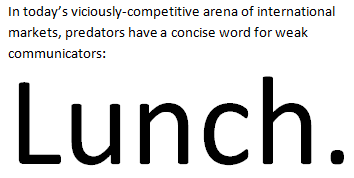
The conference Communicating in Business – Getting Language Right features speakers involved in domestic, EU and international business, law and diplomacy and some translators working at high levels of public and private service with direct clients, who all share a deep understanding of what goes missing when we waste too much time fussing over technologies and forget that these are merely the form - irreplaceable human knowledge and skill in communication are most often the content that matters, especially so when one deals with the most important services, products, legal, social and political issues.
It's nice to see the rigid, repetitive mold of yet another Are You Ready for the Future of Translation Technology? event replaced by one that offers substance, nourishment and useful interactions for those who do not aspire to the compromised communication practices of the anonymized bulk market but instead concern themselves with carrying messages most effectively to those who want and need them.
I am a strong believer in good technology, properly applied, but private reports of a recent major translation project where all the processes worked perfectly, with translation memory tools, terminology review, planned workflows, etc. delivered an absolutely flawless format, perfect consistency and all of it perfectly unusable because the most important element was left out: the real communication specialists, the expert linguists who know the subject matter to be translated and how best to express it for another culture in the language needed. That's what the Stridonium conference is about - sharing best practice and working together as true partners in communication to stay on top of the top of the game.
Riccardo Schiaffino's About Translation blog has details of the conference, which can also be found on the Stridonium events pages.
An exploration of language technologies, translation education, practice and politics, ethical market strategies, workflow optimization, resource reviews, controversies, coffee and other topics of possible interest to the language services community and those who associate with it. Service hours: Thursdays, GMT 09:00 to 13:00.
Showing posts with label direct clients. Show all posts
Feb 5, 2014
Dec 5, 2012
Clients get the translators they deserve
A guest post by Valerij Tomarenko
How can a client benefit from a translator’s advice? How can s/he achieve best results when working with translators?
Since I studied music and was educated as a musician (apart from graduating from another Russian university as a philologist/translator/foreign language teacher), a music analogy came to my mind: a relationship between composer and performer. They say Bach’s last works were meant neither for instruments nor voices, they were intended to be studied rather than heard. A “normal” composer, however, creates music for a specific instrument/voice or a group of instruments or voices in mind. By studying orchestration, a composer gets to know various instruments and learns how to best use them to produce the desired results. That goes hand in hand with, generally, making life easier for the performer. A composition should be playable, an instrument player fretting over ridiculously complicated fingering is not a good ally. The comparison might be somewhat new, but what I am driving at isn’t: it is common advice for authors of technical or corporate documentation to keep in mind that, for eventual translation, they’d better produce translatable text. Without getting into details of writing conventions or localisation guidelines, I would urge caution on too much corporate lingo or, on the other hand, too heavy, even if seemingly natural, idioms. To translate the German “0815” is not a problem, but please bear in mind that a German “Punkt in Flensburg” would hardly sound that short in any target language (my spellchecker just tried to make a “Punk” out of “Punkt”, but anyway, the most commonplace examples to this effect are not German, but American, e.g. baseball idioms in American everyday language.
I will not discuss the technicalities of preparing documents for translation, since I expect others will do so. But again, another thing which came to my mind has to do with relationships. Kevin’s request to share some ideas and advice coincided with my leafing through the pages of “Ogilvy on Advertising”. The book, first published 30 years ago, still holds true not only for the advertising industry. After all, advertising is about convincing (or call it persuasion) and so is, to a large extent, our translation business (think writing skills). Chapter 6 of Ogilvy’s book is called “Open letter to a client in search of an agency”. Much of his advice is applicable to translators. (I don’t mean translation agencies, rather freelance translators.)
One piece of advice I’d rather quote verbatim:
“Even the best copywriters are preternaturally thin-skinned”, Ogilvy says. It is true of many translators. So, when explaining things, don’t be overwhelmingly paternalistic. As a rule, experienced freelance translators are both knowledgeable and also capable of thinking out of the box (that is to say they are probably less susceptible to corporate tunnel vision than some of your staff).
As regards motivation, Ogilvy suggests insisting (!) on paying more that what the agency normally charges. “The extra percent won’t kill you... and you will get better service.” I think it also enhances trust and confidence on both sides. Translation is not a commodity. For a serious translator, it is important to feel that the client is well aware of this fact. Very often, when the first (and only) question from a potential client is about my “per unit“ price (words, lines or pages), I’m inclined to ask whether this potential client also considers price to be the most important (or only) reason for his/her own products or services.
And, last but not least, I think that building a longtime relationship with the translator (your very special, not easily replaceable translator) really pays off as s/he is gaining ever more experience and knowledge of your company. In the end it all boils down to the ancient advice about treating your translator as you wish to be treated yourself. It is in the Bible and, as the rabbis say, the rest is commentary.
Valerij Tomarenko is an established colleague for Russian, German and English translation and interpreting based in Hamburg, Germany. His blog, Anmerkungen des Übersetzers, is often a source of useful insight in both German and English as well as of his delightful photography.
As part of a small article I was researching, I asked several colleagues whose professional experience in language services extends far longer and usually deeper than my own if they could summarize their best advice for translation buyers in 50 words or less. My intent was to see what different points these experts chose to emphasize, what they had in common and where they differ. The responses so far are quite interesting and will be shared in various ways in the future. Few have managed to stick to the 50 word brief, and my friend Valerij has been a particularly egregious violator of that concept. But as is so often the case in my exchanges with him, I can't find a word to cut which would not detract from the quality of a message worth sharing, so with his kind permission I have adapted this private correspondence for the blog, because I feel these points are really worth contemplation.
How can a client benefit from a translator’s advice? How can s/he achieve best results when working with translators?
Since I studied music and was educated as a musician (apart from graduating from another Russian university as a philologist/translator/foreign language teacher), a music analogy came to my mind: a relationship between composer and performer. They say Bach’s last works were meant neither for instruments nor voices, they were intended to be studied rather than heard. A “normal” composer, however, creates music for a specific instrument/voice or a group of instruments or voices in mind. By studying orchestration, a composer gets to know various instruments and learns how to best use them to produce the desired results. That goes hand in hand with, generally, making life easier for the performer. A composition should be playable, an instrument player fretting over ridiculously complicated fingering is not a good ally. The comparison might be somewhat new, but what I am driving at isn’t: it is common advice for authors of technical or corporate documentation to keep in mind that, for eventual translation, they’d better produce translatable text. Without getting into details of writing conventions or localisation guidelines, I would urge caution on too much corporate lingo or, on the other hand, too heavy, even if seemingly natural, idioms. To translate the German “0815” is not a problem, but please bear in mind that a German “Punkt in Flensburg” would hardly sound that short in any target language (my spellchecker just tried to make a “Punk” out of “Punkt”, but anyway, the most commonplace examples to this effect are not German, but American, e.g. baseball idioms in American everyday language.
I will not discuss the technicalities of preparing documents for translation, since I expect others will do so. But again, another thing which came to my mind has to do with relationships. Kevin’s request to share some ideas and advice coincided with my leafing through the pages of “Ogilvy on Advertising”. The book, first published 30 years ago, still holds true not only for the advertising industry. After all, advertising is about convincing (or call it persuasion) and so is, to a large extent, our translation business (think writing skills). Chapter 6 of Ogilvy’s book is called “Open letter to a client in search of an agency”. Much of his advice is applicable to translators. (I don’t mean translation agencies, rather freelance translators.)
One piece of advice I’d rather quote verbatim:
“Don’t keep a dog and bark yourself. Any fool can write a good advertisement, but it takes a genius to keep his hands off a good one. I had just finished showing a new campaign to Charlie Kelstadt, the Chairman of Sears Roebuck, when his Comptroller came into the room, started to read my copy – and took a fountain-pen out of his pocket. ‘Put that pen back into your pocket’, snapped Kelstadt.”Ogilvy’s situation, I am afraid, rings familiar bells for many fellow translators. Whereas you outsource a translation job to a freelancer (or an agency, for that matter), your company may have native speakers of the respective language. (Or your CEO’s family has an au pair from this or that country, of all things.) Sometimes it is a good idea to ask their opinion, but more often than not I, in such a situation, had to correct the correction again and, embarrassing for both sides, explain mistakes. More often than not, there was no need for internal correction or censorship altogether. Trust your translator, if you care about motivation.
“Even the best copywriters are preternaturally thin-skinned”, Ogilvy says. It is true of many translators. So, when explaining things, don’t be overwhelmingly paternalistic. As a rule, experienced freelance translators are both knowledgeable and also capable of thinking out of the box (that is to say they are probably less susceptible to corporate tunnel vision than some of your staff).
As regards motivation, Ogilvy suggests insisting (!) on paying more that what the agency normally charges. “The extra percent won’t kill you... and you will get better service.” I think it also enhances trust and confidence on both sides. Translation is not a commodity. For a serious translator, it is important to feel that the client is well aware of this fact. Very often, when the first (and only) question from a potential client is about my “per unit“ price (words, lines or pages), I’m inclined to ask whether this potential client also considers price to be the most important (or only) reason for his/her own products or services.
And, last but not least, I think that building a longtime relationship with the translator (your very special, not easily replaceable translator) really pays off as s/he is gaining ever more experience and knowledge of your company. In the end it all boils down to the ancient advice about treating your translator as you wish to be treated yourself. It is in the Bible and, as the rabbis say, the rest is commentary.
****
Valerij Tomarenko is an established colleague for Russian, German and English translation and interpreting based in Hamburg, Germany. His blog, Anmerkungen des Übersetzers, is often a source of useful insight in both German and English as well as of his delightful photography.
As part of a small article I was researching, I asked several colleagues whose professional experience in language services extends far longer and usually deeper than my own if they could summarize their best advice for translation buyers in 50 words or less. My intent was to see what different points these experts chose to emphasize, what they had in common and where they differ. The responses so far are quite interesting and will be shared in various ways in the future. Few have managed to stick to the 50 word brief, and my friend Valerij has been a particularly egregious violator of that concept. But as is so often the case in my exchanges with him, I can't find a word to cut which would not detract from the quality of a message worth sharing, so with his kind permission I have adapted this private correspondence for the blog, because I feel these points are really worth contemplation.
-- Kevin Lossner
Sep 29, 2012
We are the wind beneath their wings
I've been translating now for some 35 years, though the first two decades and a bit more I did so to support my personal interests and research rather than to pay my way. But I've had a close eye on many developments in the profession since my student days, when I dabbled in Russian to German translation and a bit of Sumerian, and later, when I was married to a sometime translator, I watched as technology began to have a greater impact on the profession. I can even plead guilty to having introduced modern computer-aided translation technology to an unsuspecting corporate translation department, which was dissolved about a year later as the company realized that outsourcing kept the translators on their toes and prevented some too-frequent abuses.
There are many advantages to having an in-house translation team. Those who are part of one or who have one in their organization can likely cite these better than I can. One of the greatest advantages I see is continuity: the translators and editors know the products and the people who create them and usually use terminology more appropriately and represent product characteristics more accurately. Let's not talk about the horrors of L2 translation (into one's second, third or fourth language) imposed by management that often does not understand linguistic competence and how best to use it in the corporate interest.
Some understand these matters, at least in principle, and rely on experts to guide and support them. For a very long time, translation agencies have been part of this network of experts. There are good ones and bad ones, and I have known very many good ones, and I continue to support some of these as a translator and consultant. But the raw truth is that most of the time, using a translation agency is a poor substitute for the relationship needed to sustain or even enhance one's foreign language communication. And many of my experiences in the past few years lead me to the conclusion that even the best agencies as they are now operated are not in their clients' best interests.
I think that Once Upon A Time the translation business was relatively straightforward and did not challenge the business skills of many translators and agency operators much. There were - and continue to be - great inefficiencies, but in the manure of that inefficiency a good amount of healthy expertise flourished and nourished those who called on our profession for assistance. Expectations were perhaps often lower (at least with regard to schedules) and I imagine they were often exceeded. Perhaps not; old hands can enlighten me.
Now, however, one sees a commoditization of our "product" - expression in other languages and cultural contexts - and a widening gap between the linguistic "haves" and "have nots". Experienced agencies whose management has usually long since ceased to live from their personal labor of words have jettisoned in-house translation competence and rely on a juggled network of external language service providers (often referred to as freelancers) to do the work as young, inexperienced clerks shuffle schedules, quote projects by outdated and/or inaccurate means and off-load anything requiring technical competence to other "departments" or the external translators themselves.
It's a dirty secret that the pool of truly good translators and revisers is very limited in many specialties, even in the most common language pairs. Or at least the pool from which dozens or hundreds or even thousands of agencies draw is very small. Many of us have been asked to revise our own work by an agency which was not contracted for the original translation. Conversations with agency owners and product managers in organizations with high standards reveal time and again that they use the same list of a half dozen or fewer people for their best work involving law and science. So even if you, the corporate translation consumer or private individual with translation needs, choose the best agencies around, there is absolutely no guarantee that they will get the best translators for you. In fact, very often your work will be auctioned off on public sites like human exports from Africa used to be about two centuries ago, or it is pandered in mass mailings and given to "first response linguists" who might be good at some things but not at yours.
What can be done about this? A lot actually. Most of us wouldn't think of relying on streetwalkers for our social support and personal health, and building a relationship with linguists who will loyally and competently provide you with the best service you can hope for is easier than you might imagine. It starts by finding and connecting with the right people. And understanding the fair value for the services you require.
The mangled words in the picture above were photographed on the wall of an exhibitor's booth at the recent Security trade fair in Essen. I had my camera with me and, as I walked the floor with my copywriting partner, I could have taken similarly appalling photos at nearly every display in nine full exhibition halls. Some of these were the result of in-house "expertise"; many were the unhappy result of being serviced by agencies and their outcall "translators". Imagine the damage to corporate images!
There is a reason why premium freelance language service providers like Chris Durban have long passed cent per word benchmarks for piece rate translation that many of the better agencies consider unachievable and why others I know charge on a schedule similar to a good attorney. This is because smart companies and individuals understand that good communication is critical to surviving a difficult market.
After the day at the trade fair, I talked to an agency friend who told me how happy his end client (who exhibited there) was with recent work I had provided, how much better the service was than anything the company had received before. Small mis-steps like giving earlier projects to a cheaper, less experienced translator after I had helped to acquire the client in the first place (and been promised the business into English) were forgotten. And I imagine that future relations with this valuable manufacturer of high quality safety equipment will soar as they should with a competent team. When I spoke to a freelance copywriter later and told her how, in the current market, I often have a picture in my head of many good translation agencies as biplanes, trailing a bit of smoke and losing altitude, coming close to the trees or to crashing into a hillside. Then they are borne up suddenly with an updraft of air, a competent translation or revision from a skilled linguist with an understanding of the field and a sensitivity to the psychological nuances of words. They rise and fly safely for a while until once again that saving wind is needed. She thought about that image, and about her future, and told me "This draught of air isn't drafting any more."
There are many advantages to having an in-house translation team. Those who are part of one or who have one in their organization can likely cite these better than I can. One of the greatest advantages I see is continuity: the translators and editors know the products and the people who create them and usually use terminology more appropriately and represent product characteristics more accurately. Let's not talk about the horrors of L2 translation (into one's second, third or fourth language) imposed by management that often does not understand linguistic competence and how best to use it in the corporate interest.
Some understand these matters, at least in principle, and rely on experts to guide and support them. For a very long time, translation agencies have been part of this network of experts. There are good ones and bad ones, and I have known very many good ones, and I continue to support some of these as a translator and consultant. But the raw truth is that most of the time, using a translation agency is a poor substitute for the relationship needed to sustain or even enhance one's foreign language communication. And many of my experiences in the past few years lead me to the conclusion that even the best agencies as they are now operated are not in their clients' best interests.
I think that Once Upon A Time the translation business was relatively straightforward and did not challenge the business skills of many translators and agency operators much. There were - and continue to be - great inefficiencies, but in the manure of that inefficiency a good amount of healthy expertise flourished and nourished those who called on our profession for assistance. Expectations were perhaps often lower (at least with regard to schedules) and I imagine they were often exceeded. Perhaps not; old hands can enlighten me.
Now, however, one sees a commoditization of our "product" - expression in other languages and cultural contexts - and a widening gap between the linguistic "haves" and "have nots". Experienced agencies whose management has usually long since ceased to live from their personal labor of words have jettisoned in-house translation competence and rely on a juggled network of external language service providers (often referred to as freelancers) to do the work as young, inexperienced clerks shuffle schedules, quote projects by outdated and/or inaccurate means and off-load anything requiring technical competence to other "departments" or the external translators themselves.
It's a dirty secret that the pool of truly good translators and revisers is very limited in many specialties, even in the most common language pairs. Or at least the pool from which dozens or hundreds or even thousands of agencies draw is very small. Many of us have been asked to revise our own work by an agency which was not contracted for the original translation. Conversations with agency owners and product managers in organizations with high standards reveal time and again that they use the same list of a half dozen or fewer people for their best work involving law and science. So even if you, the corporate translation consumer or private individual with translation needs, choose the best agencies around, there is absolutely no guarantee that they will get the best translators for you. In fact, very often your work will be auctioned off on public sites like human exports from Africa used to be about two centuries ago, or it is pandered in mass mailings and given to "first response linguists" who might be good at some things but not at yours.
What can be done about this? A lot actually. Most of us wouldn't think of relying on streetwalkers for our social support and personal health, and building a relationship with linguists who will loyally and competently provide you with the best service you can hope for is easier than you might imagine. It starts by finding and connecting with the right people. And understanding the fair value for the services you require.
The mangled words in the picture above were photographed on the wall of an exhibitor's booth at the recent Security trade fair in Essen. I had my camera with me and, as I walked the floor with my copywriting partner, I could have taken similarly appalling photos at nearly every display in nine full exhibition halls. Some of these were the result of in-house "expertise"; many were the unhappy result of being serviced by agencies and their outcall "translators". Imagine the damage to corporate images!
There is a reason why premium freelance language service providers like Chris Durban have long passed cent per word benchmarks for piece rate translation that many of the better agencies consider unachievable and why others I know charge on a schedule similar to a good attorney. This is because smart companies and individuals understand that good communication is critical to surviving a difficult market.
After the day at the trade fair, I talked to an agency friend who told me how happy his end client (who exhibited there) was with recent work I had provided, how much better the service was than anything the company had received before. Small mis-steps like giving earlier projects to a cheaper, less experienced translator after I had helped to acquire the client in the first place (and been promised the business into English) were forgotten. And I imagine that future relations with this valuable manufacturer of high quality safety equipment will soar as they should with a competent team. When I spoke to a freelance copywriter later and told her how, in the current market, I often have a picture in my head of many good translation agencies as biplanes, trailing a bit of smoke and losing altitude, coming close to the trees or to crashing into a hillside. Then they are borne up suddenly with an updraft of air, a competent translation or revision from a skilled linguist with an understanding of the field and a sensitivity to the psychological nuances of words. They rise and fly safely for a while until once again that saving wind is needed. She thought about that image, and about her future, and told me "This draught of air isn't drafting any more."
Jan 17, 2012
Are professional organizations worth the bother?
There are two broad categories of professional organizations potentially of interest to language professionals such as interpreters and translators: those which are intended specifically for providers of language services, such as freelance translator and interpreters, and those which are not. The latter, which would include chambers of commerce, business clubs, technical societies such as the American Chemical Society and so on are clearly of great value. They are a means to stay abreast of new developments in areas of interest (perhaps an earlier profession) and perhaps to meet potential direct clients.
What about the other kind, professional associations for editors, translators, interpreters, terminologists and other language-slinging rabble? Well, as one reader from Putinland commented on my post about finding good translators, she saw no single benefit to her membership in that country's largest translators' association. She was aghast at the idea that someone might cancel a ProZ membership, because she assumed that corporate clients would not look for professionals but instead would only work with agencies, and these agencies in turn would cast their nets at The Translators Workhouse. (I looked up Cravy's profile at The Workhouse and when I saw the wealth of information there, it was hard to imagine how agencies would not be dueling each other for the opportunity to offer her work. But that is not the right profile - see the comments. That is an ongoing problem with ProZ and other portals - anyone can set up a profile under nearly any name or pseudonym, with no verification that the person behind the registered e-mail address is real. This is why the portals are often playgrounds for scamsters.)
Fortunately, the real world isn't quite as Dickensian as that, though perhaps a bit darker and more Satanic at the wordface in some parts of the world. But King Henry's sockpuppet is partly right: all organizations are not created equal. They exist in a particular social context of the countries in which their members live or do business, and they are very much dependent on the efforts of their members.
The professional translators' organization of which I am a member, the German BDÜ, can be a real mixed bag at times; one fellow I know who places enormous value on professional conduct quit his local chapter in disgust a few years ago, referring to it as the Hessian Housewives' Association. Since then, however, he has come back and contributed to the serious business focus of his state chapter, and across Germany the organization offers first-rate continuing education seminars, free legal counseling, affordable liability insurance, an excellent private forum for members to exchange information and job requests, a superb online search tool for translators and their specialties and more. To say that I get my money's worth out of membership would be a huge understatement. I don't have to like everything the BDÜ does, but I applaud a great deal of it.
As I was compiling the list of professional organizations for freelance translators and interpreters which provide online search tools for potential clients to find a service provider, I was a little shocked at how parochial and unprofessional some of these venerable organizations appear on the Internet sites. In a discussion of that list on a private site, one colleague commented that it is a shame there isn't some sort of meta search engine to serve up the data from a great number of professional sites around the globe. I'm not really sure that would be a good thing if it were possible, and a quick look at the search tools for a few of the association sites quickly makes it clear that a programmer attempting such a task would soon turn to the bottle. There is no consistency at all in the lists of specialties used; some organizations simply list members in a given region with no statement of the types of text they feel they are fit to translate. Appalling.
I think that attracting an international clientele is important to many translators in this age; for those living in countries with developing economies, this is one of the keys to the best rates. But in order to do that, it is necessary to offer the site in languages which are probably understood by potential international clients. The Germans do it. So do the French. The Swiss and Italian associations I looked at failed this test. If you are a member of a professional association for language service providers, has your association given due attention to this point? If not, get out the thumbscrews or find and organization that does. (That's called "voting with your feet", an option familiar enough to some who live in parts of the world where that is the only effective vote.)
Linking online search engines for the associations would require using the same list of specialties or at least subsets thereof to be effective. But what chance of that is there with an organization that feels it is important to list beekeeping but nothing to do with chemistry or chemical technology? Quite a lot, I'm sure. Unifying and merging search tools might be a good project for groups like the Canadian umbrella organization I listed. I was not happy to see that I would have to go to each individual state organization to do my search. Really!
This is the 21st century, but some organizations for language specialists seem to be stuck in the 19th. The disorganization one can see in some areas, even in developed countries where one might expect better, make it obvious why even a highly flawed commercial portal that many serious professionals avoid like herpes can be a "success". But fortunately, there are some organizations, big ones, that get it and offer a hunting ground that is generally happier than the portalZ with their spotty or non-existent identity verifications for members and silly aliases. Mind you, I eventually adopted an alias myself on ProZ, but that was to avoid having information I wanted to present about myself or my business get buried in spammy pages repeating my commentary for Tamil, Swahili, Tagalog, Urdu and other languages at the center of the world stage.
So are these professional organizations for language service providers such as freelance translators, interpreters and editors worthwhile? Definitely. If you choose the right one.
What about the other kind, professional associations for editors, translators, interpreters, terminologists and other language-slinging rabble? Well, as one reader from Putinland commented on my post about finding good translators, she saw no single benefit to her membership in that country's largest translators' association. She was aghast at the idea that someone might cancel a ProZ membership, because she assumed that corporate clients would not look for professionals but instead would only work with agencies, and these agencies in turn would cast their nets at The Translators Workhouse. (I looked up Cravy's profile at The Workhouse and when I saw the wealth of information there, it was hard to imagine how agencies would not be dueling each other for the opportunity to offer her work. But that is not the right profile - see the comments. That is an ongoing problem with ProZ and other portals - anyone can set up a profile under nearly any name or pseudonym, with no verification that the person behind the registered e-mail address is real. This is why the portals are often playgrounds for scamsters.)
Fortunately, the real world isn't quite as Dickensian as that, though perhaps a bit darker and more Satanic at the wordface in some parts of the world. But King Henry's sockpuppet is partly right: all organizations are not created equal. They exist in a particular social context of the countries in which their members live or do business, and they are very much dependent on the efforts of their members.
The professional translators' organization of which I am a member, the German BDÜ, can be a real mixed bag at times; one fellow I know who places enormous value on professional conduct quit his local chapter in disgust a few years ago, referring to it as the Hessian Housewives' Association. Since then, however, he has come back and contributed to the serious business focus of his state chapter, and across Germany the organization offers first-rate continuing education seminars, free legal counseling, affordable liability insurance, an excellent private forum for members to exchange information and job requests, a superb online search tool for translators and their specialties and more. To say that I get my money's worth out of membership would be a huge understatement. I don't have to like everything the BDÜ does, but I applaud a great deal of it.
As I was compiling the list of professional organizations for freelance translators and interpreters which provide online search tools for potential clients to find a service provider, I was a little shocked at how parochial and unprofessional some of these venerable organizations appear on the Internet sites. In a discussion of that list on a private site, one colleague commented that it is a shame there isn't some sort of meta search engine to serve up the data from a great number of professional sites around the globe. I'm not really sure that would be a good thing if it were possible, and a quick look at the search tools for a few of the association sites quickly makes it clear that a programmer attempting such a task would soon turn to the bottle. There is no consistency at all in the lists of specialties used; some organizations simply list members in a given region with no statement of the types of text they feel they are fit to translate. Appalling.
I think that attracting an international clientele is important to many translators in this age; for those living in countries with developing economies, this is one of the keys to the best rates. But in order to do that, it is necessary to offer the site in languages which are probably understood by potential international clients. The Germans do it. So do the French. The Swiss and Italian associations I looked at failed this test. If you are a member of a professional association for language service providers, has your association given due attention to this point? If not, get out the thumbscrews or find and organization that does. (That's called "voting with your feet", an option familiar enough to some who live in parts of the world where that is the only effective vote.)
Linking online search engines for the associations would require using the same list of specialties or at least subsets thereof to be effective. But what chance of that is there with an organization that feels it is important to list beekeeping but nothing to do with chemistry or chemical technology? Quite a lot, I'm sure. Unifying and merging search tools might be a good project for groups like the Canadian umbrella organization I listed. I was not happy to see that I would have to go to each individual state organization to do my search. Really!
This is the 21st century, but some organizations for language specialists seem to be stuck in the 19th. The disorganization one can see in some areas, even in developed countries where one might expect better, make it obvious why even a highly flawed commercial portal that many serious professionals avoid like herpes can be a "success". But fortunately, there are some organizations, big ones, that get it and offer a hunting ground that is generally happier than the portalZ with their spotty or non-existent identity verifications for members and silly aliases. Mind you, I eventually adopted an alias myself on ProZ, but that was to avoid having information I wanted to present about myself or my business get buried in spammy pages repeating my commentary for Tamil, Swahili, Tagalog, Urdu and other languages at the center of the world stage.
So are these professional organizations for language service providers such as freelance translators, interpreters and editors worthwhile? Definitely. If you choose the right one.
Subscribe to:
Posts (Atom)