An exploration of language technologies, translation education, practice and politics, ethical market strategies, workflow optimization, resource reviews, controversies, coffee and other topics of possible interest to the language services community and those who associate with it. Service hours: Thursdays, GMT 09:00 to 13:00.
Note: This post has been updated to reflect a planning change. The five-day trainer training course has been replaced with a two-day (eight hour) course for translators to master key memoQ features.
The CETAPS institute at Universidade Nova de Lisboa FCSH has planned a week-long (20-hour) memoQ online project management training course and a two day (8-hour) course on memoQ mastery for translators in the latter part of January 2024 which might be of interest.
The first course (from January 22nd to 26th) will be for those in project management roles or similar functions using memoQ TMS servers; it will begin with a day of intense review and instructional guidance for memoQ basics in online projects from a translator and reviewer perspective and proceed from there to topics such as online project creation and administration, rights and resource management, template use, optimal preparation workflows, mid-project updates and more as well as participant-specific issues. The cost is €480.
The second course (from January 29th to 30th) is aimed at translators and reviewers, who want to better understand and handle project workflows for both their own projects and agency-created ones. This will include resource customization, project management, project templates, file import filters, and project navigation, including some regular expressions magic. The cost is €90.
Further information on the course and an enrollment form can be found HERE. The registration period has been extended and enrollments will be accepted through January 5th. Questions regarding the program and enrollment can be directed to Prof. Marco Neves (e-mail: mfneves@fcsh.unl.pt).
Certificates will be issued to all participants completing the courses. Course availability is subject to sufficient enrollment.
The fifth open office hours session for the self-guided online course "memoQuickies Resource Camp" discussed segmentation problems with documents imported to translation environments such as memoQ, Trados Studio, Phrase, Cafetran Espresso, etc. and various ways that these issues might be identified so that they can be corrected.
Segmentation problems waste enormous amounts of time, and bad segmentation rules are a plague on the translation and localization service community. Unfortunately, nearly all the rules I have seen, for all working environments, simply suck sewage. memoQ's rules usually suck less, but still....
This week's talk presented, among other things, some methods for identifying segmentation trouble spots quickly and easily with the use of special regular expressions describing common patterns followed by texts with troubled segmentation. And a Regex Assistant library has been provided (and will be updated during the course period) to help with all of this.
The video and related course pages will remain completely open to the public, with downloads available, at least through the end of 2023. After that the pages and resources may be taken down for updates and reorganization in other courses.
The video recording of the lecture "What's wrong with my segmentation?" can be accessed on YouTube (embedded below) or course participants can access the page to download it by clicking the "segmentation rules" icon at the top of this article.
An important part of checking the performance of your segmentation rules and possibly improving them is to have a good sampling of test data. One of my favorite sources for this are the European Community archives at the DGT, where EU legislation and other important information is available in a parallel corpus of all the official languages of the Community.
Payment practices are a perpetual pain in Trashlation World. What professional translator or interpreter has not, at some point, faced difficulty getting paid for work delivered. Or in my case, consultant, independent solution developer and instructor, since I retired from translation three months ago and no longer accept such tasks in the increasingly thankless environment where they are requested.
Net never has become the modus operandi of too many wankers in the NMT-AI-MOUSE Fanboy and -gurl Klub, and when B of A, Barclays, Santander of some other clan of thieves fails to provide the desired credit for the Incredible Journey to Ruin, there will always be those AI Artists Formerly Known as Trashlators who understand that in matter of money, all that really matters is mindset.
Fuck you. Pay me. Well, imagine getting paid! Isn't that exciting? Fuck you. Pay me. I'm more excited by the structure of your fucking kneecaps and how fragile it is... SET YOUR MIND TO PAY ME.
But wait, Paulie, there may be a better way!
A perpetually solvent friend who owns a couple of German service companies once shared his secret: when in doubt, demand payment in advance. When there is no doubt, demand double. But what if the prospect just walks away? Offer them a peck on the check and hold the door for them in gratitude for the grief they are about to save you.
Times are hard. But payment practices are, alas, too often limp. Like a little mushroom past its sell-by date and full of mold and other things best not named.
I'm personally fortunate not to deal with many deadbeats; avoiding business with Italian and American companies certainly helps. Well, I have a soft spot for the Portuguese, but let's not go there.
I have another problem. I had administrative work even more than I hate not getting paid, and since I acquired a retired surgeon as a billing assistant and, at about the same time, took on a new role as a trainer for incoherent billing software like SAGE, not getting paid has been a source of surprising pleasure. But our five dogs still demand food, and if it does come in bags and come on time, well... there is that extra weight I'm carrying, the Portuguese pit bull is fond of reminding me.
And I am sure that many clients and friends and friends with the misfortune to be clients keep a special dartboard with my face on it for those times I get around to writing the bill after a year of so.
Fuck you. Pay me. Well fuck you. Write the fucking bill. Yeah, right, you tell me again how all that works here in Portugal where the tax laws are so screwy that almost none of the invoicing tools typically used by translators, companies involved with language services (regardless of whether they actually provide any) in other countries are compliant with Portuguese tax law, so I often feel myself well and truly fucked.
Enter the performance platforms such as Fiverr, which I am beginning to consider for certain recurring requests where I have asked Dios for a better intake process in which people tell me exactly what they need, provide the means of doing that, including the money to pay for the electricity to drive the tools I use to reach their goal and, well, just let me get on with it and make something nice and bless them for a change.
I started toying with platformed pre-payment about four years ago, when I started using Teachable as a way to demonstrate to memoQ and others how professional tools instruction could be improved and content could be shaped in more useful ways. I may not have been successful in convincing others to Do the Right Thing, but now that I have more time on my hands and have resigned myself to take a shot at that myself and maybe actually charge for all that knowledge that so many people mint money with, I am really, really glad that the Portuguese tax mysteries are handled in a way that does not involve me at all and is completely correct. No more constant special requests for special invoices for special people in special countries and special claims on my non-existent admin time.
So, that's the news, I guess. Next time you need a training video, a dash of regex for your project soup, a magical mysterious import filter for Formats Unknown or the like, there's a process. And it's not "fuck you". That's between consenting buyers and the platforms from which they draw their services....
Eleven months ago I was supposed to talk about terminology in a three-hour evening class taught by one of my friends at Universidade Nova de Lisboa, but I was so excited about the progress of the quality team I was training at one of my agency clients in Portugal that I twisted what was expected to be my usual straightforward 90 minute lecture on term base best practices in memoQ into an unusual take on the role regular expressions might play in terminology management.
That was a weird one, for sure, but the potential I saw was very real. I was defining "terminology" in rather broad terms to include not only more efficient term base management based on problem patterns but also translation memory clean-up, better filtering and find/replace operations in the working grid and QA.
"What the heck has all that got to do with scary ol' REGEX?" you're probably thinking.
Well, all this was triggered by memoQ's recent release of the One Ring Thing we've been needing to unify our memoQ management processes for the routine use of regex by The Rest of Us. The Regex Assistant. The Nazgul of Trados World are surely jealous.
I was so amazed to see people who had struggled for years to learn regex well enough for simple tasks suddenly become solution powerhouses that I put together (rather spontaneously) a series of three online 90-minute workshops, which were repeated a month later. And new refinements to these methods come each time the ideas are presented.
The raw recordings of those six workshops are included in the current online course ("memoQuickies Resource Camp"), but one - the first of six - is publicly available on YouTube, where you can have a look.
However in the memoQuickies Resource Camp, a self-guided course that is serving as a platform for me to organize and distribute the best resources from my 14 years as a memoQ user, solution provider and trainer before I retire, I'll be taking another more streamlined pass at teaching some of the best possibilities for using memoQ Regex Assistant resource libraries. The webinars offered in most weeks of the course are simply an overview of the current topic emphasized in the course and also serve as a Q&A platform and a means of offering some different perspectives on information from the self-guided units. Recordings are always added to the course for later viewing.
This coming Thursday at 15:00 Central European Time, I'll give a brief overview of the Regex Assistant much like the public YouTube video does and answer any questions that attendees might have. Further information and an event notice can be found here on LinkedIn.
You can join the webinar with this link. The meeting ID is 878 3540 2561, and the passcode is 385434
Summer is almost over, but technically, "camping season" will continue in memoQ World until November 30th. Or maybe January 31st, depending on how you count.
Today, a three-month journey of exploration begins, covering six important kinds of resources to make work with the memoQ translation desktop and server environments more pleasant and efficient... and profitable. This self-guided online course will give participants full access to my 14 years of cumulative experience as a memoQ user translating, managing projects and developing hundreds of solutions with this world-leading productivity tool.
Click here or on the icon bar above to have a look at the course description and to see (and maybe download) some of the publicly available information and resources for better work in many language pairs.
The emphasis of teaching will shift to a new resource every two weeks (with auto-translation rules as the main topic for the first two weeks), but throughout the course, information will be added continuously to all topic sections as I trawl through, sort, upgrade and publish the best or most interesting stuff from my archives. And course participants have access to open virtual office hours each week on Thursdays and some other occasions, where any questions can be asked and special requests made.
A special enrollment discount of 40% is available for the first week (code: HALFOFFLAUNCH) until September 10th, but you can join at any time and work with any of the material posted, ask questions and receive feedback. Learning material and downloadable, ready-to-use and -adapt resources will continue to be added until the end of November, and the full course will remain online through January 2024. Enrollment fees and content are subject to change without notice.
Addendum 1:On Thursday afternoon, September 7th, 2023, a presentation was made to introduce the first course topic - "Auto-translation Rules for Everyone". The recording and slides can be foundhere.
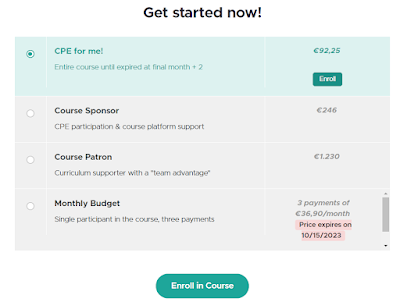
Addendum 2:Payment options for groups and monthly budgets have been introduced now. These options enable teams, departments and organizations to obtain blocks of passes for their members to receive continuing professional education in translation workflow tools. The host site applies VAT and other taxes where relevant and generates appropriate invoices. All relevant information can be found at the bottom of the information and enrollment page.
The new online school offers a variety of resources for new and experienced users of desktop and server editions
For many years now, I have advocated for better professional education for users of translation process support software at every level. I have tested curriculum delivery platforms, better ways of making information more accessible to those who need it, and more. In a limited scope, this has been a successful effort.
My greatest hope in these efforts was to encourage professional associations, technology providers and universities to do better by their clientele. I would judge the success there as mixed, at best. The wind of change discussed, for many of them, could fill one's sails... for a voyage off the edge of their flat Earth. Their reluctance to provide even minimal indexes for navigating copious video content is simply baffling, as an example.
Even with the current pandemic, I have seen little progress, though that may be as much for reasons such as those which kept me largely silent last year. It's hard to think about doing things better when you have to ask honestly which of the people you care for will be lost because of the refusal of so many national governments to do so.
In any case, I've always been one to advocate more personal involvement. If a person says they're hungry, give them food and listen to their stories. Cash may not be the answer. The courses, consulting and resources offered through my license of the Teachable platform will cover much of issues and assistance for which I have been an advocate in the translation sector for two decades. I also hope to involve other language service educators to offer their unique and valuable approaches in this venue. This is not to compete with any existing associations or companies, but rather to continue to show them how we can all work together to help users develop the competence and confidence so often needed and not found.
This, like all of us, is a work in progress. Check out Translation Tribulations Tech (here, or by clicking the school graphic at the top) and see if anything there provides missing elements for your professional toolkit.
Some of the initial offerings include:
re-released help guides I've written for learning memoQ, including some material in Portuguese. The link provided here is for a bundle which includes books and courses.
regular expressions as an aid for translation of patterned information like currency expressions, dates, legal citations, coded information, etc.
better source document segmentation in projects
memoQ server basics for collaborating groups and small companies
memoQ and other technology for legal translation
will be available soon.
This platform provides a long-needed mechanism for providing more detailed learning assistance than I have enjoyed with this blog and my YouTube channel, and future publication habits on my part will reflect that. I'm excited about many ideas for moving ahead in quick and quicker steps with memoQ and so many other resources that many of us depend on for professional relief and productivity.
Note: the pilot phase for this training course has passed, free enrollment has been closed, and the content is being revised and expanded for re-release soon... available courses can be seen at my online teaching site: https://transtrib-tech.teachable.com/
In the past few years I have done a number of long webinars in English and German to help translators and those involved in translation processes using the memoQ environment work more effectively with terminology. These are available on my YouTube channel (subscribe!), and I think all of them have extensive hotlinked indexes to enable viewers to skip to exactly the parts that are relevant to them. A playlist of the terminology tutorial videos in English is available here.
I've also written quite a few blog posts - big and small - teaching various aspects of terminology handling for translation with or without memoQ. These can be found with the search function on the left side of this blog or using the rather sumptuous keyword list.
But sometimes just a few little things can get you rather far, rather quickly toward the goal of using terminology more effectively in memoQ, and it isn't always easy to find those tidbits in the hours of video or the mass of blog posts (now approaching 1000). So I'm trying a new teaching format, inspired in part by my old memoQuickie blog posts and past tutorial books. I have created a free course using the Teachable platform, which I find easier to use than Moodle (I have a server on my domain that I use for mentoring projects), Udemy and other tools I've looked at over the years.
This new course - "memoQuickies: On Better Terms with memoQ! 10 Tips toward Term Base Mastery" - is currently designed to give you one tip on using memoQ term bases or related functions each day for 10 days. Much of the content is currently shared as an e-mail message, but all the released content can be viewed in the online course at any time, and some tips may have additional information or resources, such as videos or relevant links, practice files, quality assurance profiles or custom keyboard settings you can import to your memoQ installation.
These are the tips (in sequence) that are part of this first course version:
Setting Default Term Bases for New Terms
Importing and Exporting Terms in Microsoft Excel Files
Getting a Grip on Term Entry Properties in memoQ
"Fixing" Term Base Default Properties
Changing the Properties of Many Term Entries in a Term Base
Sharing and Updating Term Bases with Google Sheets
Sending New Terms to Only a Specific Ranked Term Base
Succeeding with Term QA
Fixing Terminology in a Translation Memory
Mining Words with memoQ
There is also a summary webinar recorded to go over the 10 tips and provide additional information.
I have a number of courses which have been developed (and may or may not be publicly visible depending on when you read this) and others under development in which I try to tie together the many learning resources available for various professional translation technology subjects, because I think this approach may offer the most flexibility and likelihood of success in communicating necessary skills and knowledge to an audience wider than I can serve with the hours available for consulting and training in my often too busy days.
I would also like to thank the professional colleagues and clients who have provided so much (often unsolicited) support to enable me to focus more on helping translators, other translation project participants and translation consumers work more effectively and reduce the frustrations too often experienced with technology.
As usual each year, the summer school at Universidade Nova de Lisboa is offering quite a variety of inexpensive, excellent intensive courses, including some for the practice of translation. This year includes a reprise of last year's Best Practices in Translation Technology from July 16th to 21st, with some different topics and approaches.
Using machine translation in a humane, intelligent way.
Using checklists to improve communication in translation.
Using glossaries, bilingual texts and other references in multiplatform environments.
Good practices for using terminology and reference texts in the target language.
Planning and creating lists for auto-translation rules and the basics of regular expressions for filters.
Some knowledge of the memoQ translation environment and translation experience are required.
The course is offered in the evening from 6 pm to 10 pm Monday (July 16th) through Friday (July 20th), with a Saturday (July 21st) session for review and exams from 9 am to 2 pm. This allows free days to explore Lisbon and the surrounding region and get to know Portugal and its culture.
Tuition costs for the general public are €130 for the 25 hours of instruction. The university certainly can't be accused of price-gouging :-) Summer course registration instructions are here(currently available only in Portuguese; I'm not sure if/when an English version will be available, but the instructors can be contacted for assistance if necessary).
Two other courses offered this summer at Uni Nova with similar schedules and cost are: Introduction to memoQ (taught by David and Marco – a good place to get a solid grounding in memoQ prior to the Best Practices course) from July 9–14, 2018 and Translation Project Management Tools from September 3–8, 2018.
All courses are taught in English and Portuguese in a mix suitable for the participants in the individual courses.