Showing posts with label cookies. Show all posts

Dec 25, 2014

Holiday cookies for the Portuguese, Part 2

Feliz natal, everyone. Around this time of year, I think of various friends and family members with their particular repertoires of seasonal cookies and other treats, which are always something I look forward to and tell myself I'll learn to make one day. This year I decided to try my hand at a favorite German cookie, which is a bit like a shortbread with its high butter content and low sugar. There are, of course, a number of recipes available online, but I wanted to try one I've enjoyed intermittently for 24 years now, and when I asked for it, this is what I got:
Heidesand: 250 g Butter schmelzen, etwas bräunen, wieder fest werden lassen. 100g Zucker und etwas Vanillezucker damit verrühren. Ein Ei, zwei gestrichene Teelöffel Backpulver und 400g Mehl hinzugeben, verkneten, kalt stellen. Rollen formen, in Zucker wälzen, in Scheiben schneiden. Ca. 15 Minuten backen bei 180°C.
Heidesand: Melt 250 g butter and brown it a bit, then let it solidify again. Cream in 100 grams of sugar and a bit of vanilla sugar. Then add an egg, two level teaspoons of baking powder and 400 g of flour; knead the dough and chill it. Form the dough into "logs" and roll these in sugar, then cut off rounds of the dough and bake them at 180°C for about 15 minutes.
I was a bit suspicious of that baking time in my oven and reduced it by several minutes, which was still too long. The first successful batch of cookies baked for about 9 minutes and probably would have been better with a bit less time.

Adjusted for US measurement units, the recipe would be
Heidesand
1 cup (2 sticks) butter
½ cup sugar
1 packet vanilla sugar or 1 tsp vanilla extract
1 egg
2 level teaspoons baking powder
3 cups white wheat flour

Melt and brown the butter somewhat, then let it cool and cream it together with the sugar, add the vanilla flavoring and egg. Then add the flour, sifting it in with the baking powder, and form the crumbly dough into rolls, which can be rolled in sugar if desired (or sugar can be sprinkled on the cut cookies before baking). Wrap these in parchment paper or other suitable material and chill the rolls in the refrigerator or freeze them. Cut off slices from the rolls and bake these at 350°F (180°C) for about 8 or 9 minutes, depending on the conditions in your oven.
I used self-rising flour for a little "boost" and carmelized the sugar, though not completely to a liquid state (throwing in a teaspoon of ground cinnamon in the process), so after it cooled I had to crush and grind it in a mortar. This resulted in cookies with an interesting speckled appearance. I also didn't bother adding extra sugar in most cases, as I prefer these cookies less sweet. They are a little dry, and crumble like sand into one's mouth when bitten.
No matter how much leavening agent is added to the mix, these cookies will not rise much due to all the butter and can be spaced closely together on the tray. This recipe is not very sweet, with about half the amount of sugar found in other versions, so those with more of a sweet tooth could adjust the sugar content accordingly.


Nov 30, 2014

Holiday cookies for the Portuguese, Part 1

Whoever told me once that "close" only counts in horseshoes and hand grenades obviously didn't know squat about baking. Given a little respect, food tends to be more forgiving than most priests in Confession.

My involvement with translation began some nearly four decades ago when an aunt gave me a battered copy of the 1897 edition of Katharina Prato's Süddeutsche Küche. My mother and I then began to translate and adapt recipes for tasty baked goods for a modern American kitchen, making educated guesses about times and temperatures and making up measurable quantities for ingredients specified in only the vaguest terms. At the time I was barely into my teens and wondered how my mother could magically interpret all that vaguery and come up with something so appealing for expanding waistlines, but those first translations taught me the importance of reinterpreting content as necessary for a new culture and different times.

With the holidays approaching and most of my interesting recipes still rumored to be in boxes in a van somewhere in Poland, I called my mother a few days ago and begged for my favorite Christmas cookie recipe - a foundational gingerbread cookie with which she often constructs frosted houses with the grandchildren at this time of year. A short time later, the miracle of e-mail brought me the following instructions:
1 cup shortening (Crisco, lard, etc.)
1¼ cups sugar
1 cup molasses
¾ tablespoon ground ginger
1½ teaspoons baking soda dissolved in 2 tablespoons hot water
½ teaspoon salt
2 rounded teaspoons cinnamon
2 eggs, beaten
6 to 6½ cups flour for a soft dough
Roll out, cut and bake at 350°F for about 10 minutes. Refrigerating the dough may make it easier to handle.
The trouble started with the shortening, but I've usually just substituted butter over the protests that "it's not the same", countering with "who cares, as long as it's good?" Moreover, butter has the advantage of keeping vegan fanatics out of one's cookie jar if they are true to the Faith. This time I discovered a big, forgotten block of Banquete creme vegetal in the fridge, and since I no longer remember why I bought the stuff, it had to go in the cookies.

Then came the molasses crisis. the English word is derived from the Portuguese melaço, but try telling that to the people of Portugal. Perhaps it's the grief over the loss of their colony in Brazil which caused them to cut their ties to this critical ingredient, but searches of several supermarkets near me have failed to turn up any trace. Oh well, brown sugar it is then.

One thing led to another, and with a why not this?and a why not that?, and a doubling of the egg content to cut the stress on the mixer motor and get rid of excess eggs, and a surprising shortage of ginger powder, which required half measures, the final mix came out as
115 g vegetable shortening (creme vegetal)  
230 g brown sugar (açucar moreno)
2 eggs (ovos)
2 teaspooons ground ginger (2 colheres de chá de gengibre em po)
1 teaspoon ground cinnamon (1 colher de chá de canela moída)
¼ teaspoon ground cloves (¼ colher de chá de cravinho moída)
¼ teaspoon fine dry salt (¼ colher de chá de sal fino seco)
450 g self-rising wheat flour (farinha de trigo com fermento)
As with most of my cookies, I creamed the fat and sugar together, then added the egg (I let the mixer do the work of beating) and spices (with the idea that the flavors will mix better in more intimate contact with the fat), followed by the flour, with the speed turned down to low and the time limited to avoid knitting the gluten in the dough.

My cookie cutters disappeared in the last move, so Plan B was to form the dough into a roll, chill it good and use a sharp knife to slice off ¼" (6 mm) thick  rounds, which were then baked for 8 minutes at about 350°F (175°C) on a parchment sheet. These cookies are lighter than the original recipe (more leavening), so they bake faster, and ten minutes in my oven puts a carbon crust on the bottom which might not be to every taste. But of course, times will need to be re-translated for the conditions of your oven.

The final result was nothing like the original, though it was rather tasty. A failed score for translation with many reviewers, I'm sure, as they stuff their faces with the culinary success.


Now it's back to the kitchen to see what happens if caramel syrup takes the place of the missing melaço,

Jul 21, 2014

Even more cookies for the Portuguese

Diabetes seems to be a rather common affliction in Portugal, which is no great wonder given the sweet tooth so many people here have. This is expressed in a great variety of cookies one finds offered in markets of every kind, most of which are quite different from the cookies familiar to me in the American and German baking traditions. As I have made batch after batch of American cookies for my friends and neighbors in Portugal, I've had a little nagging sense of guilt at what damage I might be doing contributing to their diabetic state, but the thought that cutting down their consumption of cerveja to, perhaps, a dozen bottles a day might also help with the diabetes does assuage my guilt somewhat so I can keep the grandchildren in my neighborhood supplied with a better fix than some offer in Bairro da Câmara.

Sourcing ingredients is often difficult here, partly because I'm still learning the local names of things but also because many things are simply not available. Take sheep butter, for example. As far as I know, it's only found around here at Intermarche, and the other day it was sold out, so I had to settle for goat butter. Life can be rough. If you want something really exotic like chocolate chips or cream of tartar, you just have to substitute creatively. I do a lot of that. And because I'm in Portugal, it never hurts to add garlic. It adds a new dimension to Spätzle, Portuguese-style for example.

It's actually hard to get the sugars I want here in the heart of the country. White granulated sugar? No problem, though I prefer its common yellow cousin here. But the darker stuff, açúcar moreno, isn't so easy, particularly if you like it really dark. So when I discovered a bag of deep brown sugar with a satisfying molasses whiff to it, I was delighted and snatched it up for the next batch of cookies. These were good, but turned out to be a little strange.


Not that sweet, really. Since I had tweaked other things in what was once a chocolate chip cookie recipe (goat butter, whole wheat flour, Toblerone dark chocolate bars with almond nougat), I dumbed down the other stuff and just tweaked the sugar. These cookies were even better, but still not overpoweringly sweet, then I noticed that the package bore the words "brown rice sugar". For real. I thought it was a translation error, but there really is a sugar substitute made from brown rice. And it's not bad. So I offer you this variation on the new trending cookie of Évora, chipped chocolate:
100 g brown rice sugar
125 g (
½ cup) butter (cow, goat, sheep - do what thou wilt)
Cream these together, then add
1 egg
1 tablespoon amèndoa amarga (I was out of vanilla extract)
2 teaspoons orange zest (this is the killer cookie ingredient)
Whip it some more, then add
½ teaspoon salt
½ teaspoon baking soda
225 grams flour (usually wheat of some kind, but if the spirit moves you, substitute rye, corn or oat flour as much as you like)
Mix until all the flour is evenly distributed in the wet dough, then add  
 200 g chipped baking chocolate (dark)
Drop on parchment and bake at 175°C (350°F) for something like 10 minutes.

I told my friend with diabetes that these were better for her. That might not be true, but given the response I think I'll keep lying.

And now for something completely different. I decided it was time to introduce the local Catholics to some good Chanukah tradition: sweet potato latkes served with Greek yogurt and pureed mangos. That seems to be a hit as well (with extra portions set aside for grandchildren), but afterward I was faced with the problem of half a bowl of mango puree and no idea what to do with it. So I did a little research and improvised these mango cookies, which are perhaps the best thing I've made this month:

½ cup butter
1 cup yellow sugar
¼ cup brown rice sugar
2 eggs
2 tsp vanilla
1 ½ tsp cinnamon
2/3 cup mango puree
1 tsp baking soda
1.5 cups wheat flour
1.5 cups corn flour
½ cup of milk
Cream the butter and sugars, then add egg, mango and vanilla. After the mixture is creamed, add 2 cups of flour, the baking soda and cinnamon
Bake in a preheated 375°F oven for about 10 minutes or until golden brown.
I suppose you can mess around with the sugars any way you like; I like substituting corn flours for wheat in recipes where gluten isn't needed, and I think it usually improves the character of a cookie. I may try a batch of these using just corn flour. And maybe drop the milk and use more mango puree. And a bunch of other little adjustments, because while lazy translators may crave repetitions, I find that boring in recipes, which I consider to be like German laws: there to be flouted as long as it's a victimless crime. I only make an exception with phenolphthaelin as an additive on special occasions for those on the run.

In the batch I made, it seems that the brown rice sugar was not perfectly mixed in and formed interesting little pockets, which produced a surprising effect when baked. I can't describe it; it needs to be experienced. And it is a delight!

Jul 17, 2014

The Bookshelf: a London-style hangout in the heart of Alentejo

I knew I was in the right place when, as I described the farm to which I would be moving and my satisfaction over the many rosebushes there, which would enable me to make rosewater for my mint tea, my conversation partner said "Oh, you need rosewater? I have some extra!", then fumbled around in his inventory and sent me off with half a bottle of good Algerian rosewater brought from London. I had given up on finding anything like that in the Alentejo. But then I knew it was the right place long before, with the many delicious herb teas, coffees and good food, sometimes vegetarian, offered at this very metropolitan hangout in my sleepy Portuguese university town. The couple who own and operate the business, a local woman and her Kosovar husband, lived for a few decades in London and brought some of that city's style with them to this unique café in Évora.

So when I need a quiet, air-conditioned retreat to enjoy a book, brandy and coffee or perhaps a good curry, I know where to go. And it's great to have a good chat in English about common interests in cuisine and beverages and share the latest delicious infusions of Aswan hibiscus, doum palm fruit and mint from herbs kindly provided by a colleague in Egypt. And who knows? Perhaps some of those cookies for the Portuguese will make an appearance there.

More cookies for the Portuguese

When life gives you forgotten, brown bananas

try making these cookies:
3 small brown bananas.
1.5 cups (360 ml volume, about 120 grams) of oatmeal
0.5 (120 ml volume, about 65 grams) cups golden raisins
1 egg.
Drop the batter on parchment with a spoon and bake for 12 minutes at 350°F (175°C).
I developed this recipe from a simpler one with just bananas and oatmeal which someone did for a class full of nursery school kids. I thought it needed a little more binder (an egg), and I had a bag of raisins in search of a cause. I'll probably rework the recipe later to use almond meal instead after discovering what a delight that is in a no-flour chocolate cake.

Here's a look at the results:


This was the dessert served last night with my failed attempt at Alentejan gaspacho. The cold soup must have been good, because my noiva ate two bowls of it, but that might also have been because her son wouldn't touch his. It was declared "Spanish" with tones overlaid with disgust, and I was told that I would receive instruction in a proper gaspacho soon. One where the cebola is not left out and probably with a lot more garlic. I thought that tripling the garlic in the recipe might do the trick, but it seems not.

The cookies were a hit at least, also with the neighbors at the casa de ratos ("mouse house" - home to hundreds and the source of the 33 killed here in the War on Mice).

Jun 21, 2014

When life gives you dogs, make lemonade!

Ajax (right) and his bodyguard
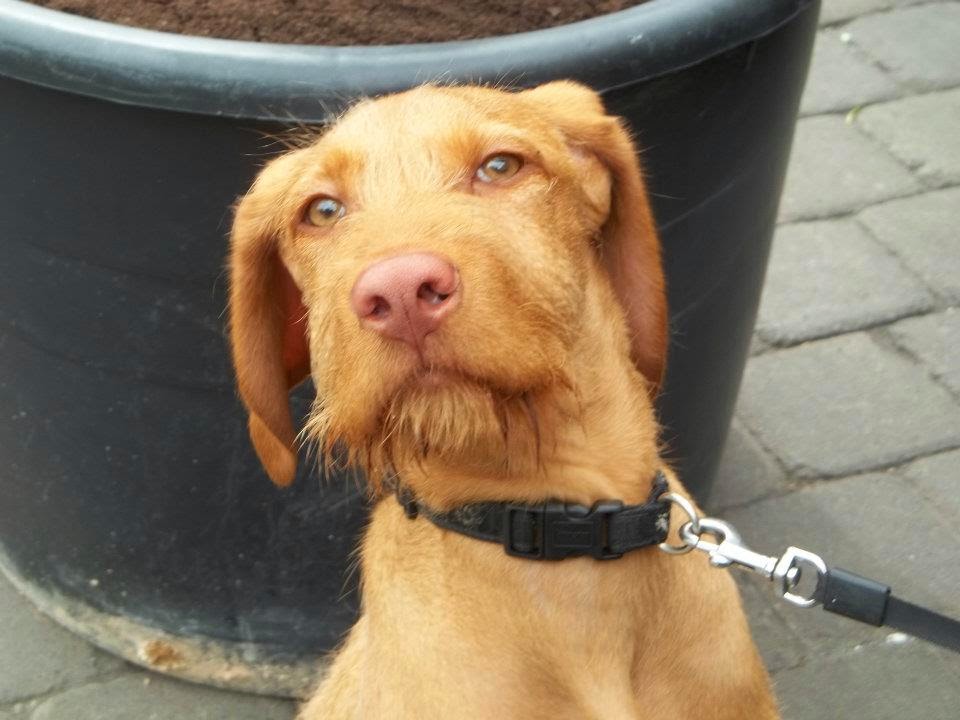
For many freelance translators working long hours alone, the companionship of animals is an indispensable part of working life. My two - Csővárberki Jámbor and Ajax vom Bernsteinsee - remind me that it's time to stop working, take breaks and do more important things like search for empty cigarette cartons and beer bottles in the park. Or take a day at the beach as in the photo above when little Jámbor decided to take on the Rhodesian Ridgeback which had just bitten through the steel chain collar of his mentor in a failed assassination attempt. Life is always interesting with those two.

Animals can also assist us in our daily chores. At my home in Portugal, I have trouble cleaning up all the oranges and lemons which fall in my back yard, so the dogs stay alert, and when they hear the sound of fruit dropping it is quickly retrieved and presented to me. This means a lot of breaks. At the moment the oranges are done, but quite a few lemons still fall. And my hunter-pointer-retrievers ensure that they do not simply lie and rot.

At the moment the bag of lemons on my kitchen floor probably weighs 10 kilos (22 US pounds) and I thought "oh God, what am I going to do with all of these???". But on hot Alentejo days and nights when the translation and language lessons require frequent replenishment of fluids and electrolytes, the answer is easy. When life gives you a home and dogs like these, make lemonade. Here's the recipe that has sustained me lately:
1 cup honey
3 cups boiling water
2 cups fresh lemon juice
Ice cubes (preferably lemon or orange juice cubes)
Pour boiling water over the honey in a pot or jug and stir util the solution is complete. Add the lemon juice. Cool (or store chilled in the fridge) and serve over ice. 
If work gets really hard you might need some cookies to go with the lemonade.

Jun 19, 2014

Cookies for the Portuguese

It all began with cookies, of course. Snickerdoodles more precisely. Then things became a soft jumble,


and chocolate chip followed with all its kinky variations.


The language lessons that began baking these cookies acquired a greater dimension, and about four days later I could converse ungrammatically but well enough with my neighbors. After a week, as she would respond to her friends who directed a stream of Portuguese at me like a firehose I kept my feet as the language soaked in and I responded in kind to her sometime surprise.

I woke and saw that the language lesson planned to greet the dawn that morning would be late. I walked carefully down the stairs, alert for cockroaches underfoot, and went to the freezer where I kept the latest batch for learning. Then a walk with the dogs and return, the door was slightly ajar and they got out again.

I searched quickly for my shoes, but then I saw that Ajax and Jambor had come back from a quick tour. No harm done.

Then I noticed the two kittens from my Portuguese tutor's litter. They had slipped in behind my dogs to visit the youngest, Jambor.
"Gostaria muito de um cigarro!"
Ajax, the cat killer, noticed then and prepared to attack.

Não!!! I screamed. Bei Fuß!
And reluctantly he came to heel as the kittens danced on the carpet with the other dog. I held the trained hunter, whose breeder and Serbian criminal who had added his Feinschliff in training had used cats to motivate Ajax to learn and obtain the coveted German Härtenachweis. I was suddenly overcome with great weariness. I fought against it, but like a castle's  great, heavy portcullis, they slammed down as I saw the kittens scamper ever closer to the waiting jaws of doom. I held desperately to the leash, but my stress-strained fingers grew numb and I fought harder to hold on, to remain conscious and in control, prevent the tragedy of the CRUNCH I heard in my sleep-dampened ears and the shake of the kill I felt in my numbing arm which held the leash.

Não!!I tried to scream again but if sound escaped my lips I could not hear it and the horror, the horror of the kill gripped like Grendel's claws on my dying heart as it was torn from my chest and I too must die no way to go back undo what was done. (The Dream)

(The Real Kill) I said good night to Sandra or rather bom dia, ate ja as she slipped out the door to fetch meds and return for another intensive Portuguese lesson. I turn at the door and saw the mother of her kittens in my living room behind me I screamed
Não!!! as Ajax noticed Jámbor dancing toward her to play, though an enemy to her always hopeful Jámbor that the cats he loves would come to play more than the occasional game of chase.
Bei Fuß!
I called and Ajax came quickly to heel bom cão and watched with interest as the queen escaped. Out the back. Out of sight. And over the back wall. Into the waiting jaws of three killers who tore her apart.

So as you try these recipes, remember that the cookies have blood on them. I am forgiven, I suppose, because after another week of lessons on a walk with the dogs at the end of a difficult day, my worse day in translation, so bad that I lost it completely, screamed out of control at the client, threw away the month's rent and food, then cut off the call, I thought the day must end otherwise so I asked her to marry she said Yes though I could not understand that single word.

Snickerdoodles (bolos de canela e açúcar)

2 3/4 cups [350 g] all-purpose flour (farinha de trigo)
1 1/2 cups [300 g] sugar (açúcar)
1 cup [250 g] butter, softened (manteiga)
2 eggs (ovos)
2 teaspoons cream of tartar (creme de tártaro / bitartarato de potássio)
1 teaspoon baking soda (bicarbonato de sódio)
1 teaspoon vanilla (baunilha)
1/4 teaspoon salt (sal)
Sugar/Cinnamon Mixture
4 parts granulated sugar one part ground cinnamon (about 5 tablespoons total)
Directions
Heat oven to 400 °F [205 °C]. Combine all cookie ingredients in large bowl. Beat at low speed, scraping bowl often, until well mixed.
Stir together about 4 tablespoons sugar and 1 tablespoon cinnamon in small bowl.
Shape dough into small balls (1"/2.5 cm); roll in sugar mixture. Place 2 inches (5 cm) apart onto ungreased cookie sheets. Bake 8-10 minutes or until edges are lightly browned.

Soft Jumbles
A simple drop batter; the finished cookie has a bit of a sponge cake consistency.

1.5 cups sugar (white, granulated)
3.5 cups white flour (low gluten)
2 tsp baking soda
1 tsp salt
1 cup sour cream
3 eggs
8 tbsp sunflower oil
Flavoring:
2 tsp vanilla extract
1 heaping tsp lemon zest
Beat the eggs, oil, sour cream and flavoring with the sugar, then sift in the flour, baking soda and salt. Mix by hand or on low power. Drop with two spoons on a cookie sheet, sprinkle with a bit of sugar or perhaps a sugar/cinnamon mix or top with a nut or raisin and bake.
In a convection oven these will take about 8 minutes at 300 °F, in a radiant oven 10 to 12 minutes at 325 °F (about 160 °C).
The flavor of the cookies develops best after they have cooled; they really don't taste like much when they are hot.

Chocolate chip cookies
(or in this case, “chipped chocolate cookies”)

100 g brown sugar (açúcar mascavado)
125 g unsalted butter (manteiga sem sal)
1 egg (um ovo)
2 teaspoons vanilla extract (2 colher de chá de extracto de baunilha)
½ teaspoon salt (½ colher de chá de sal)
½ teaspoon baking soda (½ colher de chá de bicarbonato de sódio)
225 g self-rising flour (farinha de trigo com fermento)
200 g chocolate

Cream the sugar and butter together, then add the vanilla and egg.
Sift in the salt, baking soda and flour, mixing at low power.
Chop the chocolate into small pieces, then mix in by hand or with the mixer at low power.


Using two spoons, drop the dough in small clumps onto the baking sheet, pressing the dough down slightly (if it is stiff) to ensure that it will spread and bake properly.


Pre-heat the oven to 350-400 °F (175-200 °C) and bake 7-10 minutes more or less. Watch the first few sheets of cookies carefully, and adjust the temperature and time for the conditions of your oven, avoid burning the bottoms of the cookies.
The cookies taste best when cool and freeze nicely for a long time.


“Double chocolate chip cookies” can be made by replacing 50 g of the flour by 75 g of chocolate powder. The procedure is otherwise the same.